
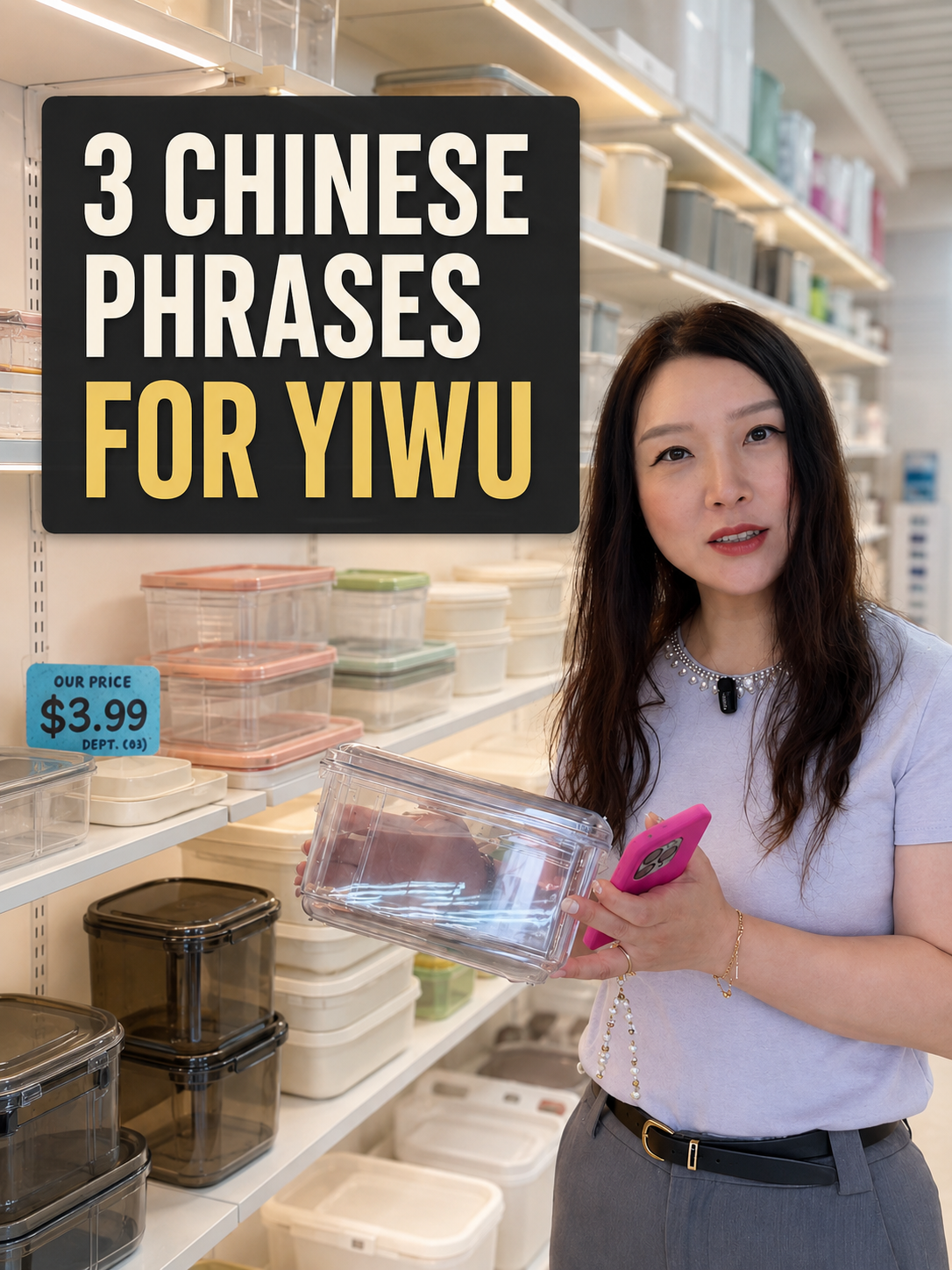
3 Chinese Phrases Every Buyer Should Know Before Visiting Yiwu Market
Coming to Yiwu Market to source products?
You do not need to speak fluent Chinese before you arrive.
But knowing three simple sourcing phrases can make your first supplier conversation much easier:
这个多少钱?
Zhè ge duō shǎo qián?
How much is this?
多少个起订?
Duō shǎo gè qǐ dìng?
What’s the MOQ?
多久出货?
Duō jiǔ chū huò?
How soon can you ship?
These three questions are simple.
But together they cover three of the most important parts of an initial sourcing conversation:
Price
Minimum order quantity
Lead time
If you are visiting Yiwu for the first time, these are good phrases to learn before entering the market.
More importantly, you should also understand what to ask after the supplier gives you the first answer.
Because in China sourcing:
Price is rarely just a number.
MOQ needs context.
And “ready soon” needs an exact date.
Phrase 1: 这个多少钱?
Zhè ge duō shǎo qián?
Meaning: “How much is this?”
This will probably be one of the first Chinese sentences you use in Yiwu Market.
You see a product.
Pick it up.
Then ask:
这个多少钱?
It is simple, direct, and widely understood.
But for a professional buyer, the supplier's first number should only be the beginning of the conversation.
Why Is “How Much?” Not Enough?
Suppose the supplier answers:
$1.20
Before deciding whether that is a good price, ask:
$1.20 for what exactly?
The quotation may depend on:
Quantity
Product size
Material
Color
Packaging
Logo
Specification
Order terms
A product displayed at a market booth may also have several different versions.
Two products may look almost identical while having different materials or quality levels.
So do not compare suppliers using only the first number you hear.
Ask What the Price Includes
After asking:
这个多少钱?
clarify:
What quantity is this price based on?
Does it include packaging?
Which material or specification?
Which size?
Which color?
Does it include a logo?
Is this a stock-product price or customized-production price?
For example:
Supplier A says:
$1.00
Supplier B says:
$1.20
Supplier A may appear cheaper.
But Supplier A may be quoting:
Product only
while Supplier B includes:
Product + retail packaging
Now the quotations are not directly comparable.
Price Should Always Be Connected to a Specification
A useful quotation should eventually become something like:
Product: Storage box
Size: 25 × 18 × 10 cm
Material: Confirmed version
Quantity: 500 PCS
Packaging: Individual polybag
Price: $X/PC
Now the price actually means something.
Without specifications, a low number can be misleading.
Do Not Ask Only for the “Cheapest Price”
It may be tempting to walk through Yiwu Market asking every supplier:
“Lowest price?”
But that can produce the wrong comparison.
If suppliers are trying to reach an extremely low target, they may offer:
Lighter materials
Smaller sizes
Simpler packaging
Different specifications
Eventually, you may be comparing completely different products.
A better sourcing question is:
“What is your price for this exact version at my expected quantity?”
Phrase 2: 多少个起订?
Duō shǎo gè qǐ dìng?
Meaning: “What’s the MOQ?”
MOQ means:
Minimum Order Quantity
This is one of the most important questions for small importers, ecommerce sellers, wholesalers, and buyers testing new products.
You may find a product you love.
The price looks good.
Then the supplier says:
MOQ: 3,000 PCS
If you only want 200 pieces, the product may no longer fit your sourcing plan.
That is why MOQ should be discussed early.
MOQ Is Not Always One Simple Number
A supplier may say:
MOQ 500 PCS
But you still need to ask:
500 PCS total—or 500 PCS per color?
This distinction can completely change the order.
For example:
Option A
500 PCS total
5 colors × 100 PCS
Option B
500 PCS per color
5 colors × 500 PCS
Total:
2,500 PCS
Those are very different inventory commitments.
Ask Whether MOQ Is Per Product, Color, or Design
After hearing the MOQ, clarify whether it applies to:
Total order
Each SKU
Each color
Each size
Each design
Each logo
Each packaging version
This is especially important when sourcing:
Apparel
Accessories
Household goods
Gifts
Promotional products
A supplier saying:
“MOQ 100.”
does not automatically mean you can order:
20 red + 20 blue + 20 green + 20 yellow + 20 black.
Ask first.
Stock MOQ and Production MOQ Can Be Different
Another useful distinction is:
Ready Stock
Products already exist.
The supplier may allow smaller quantities.
New Production
The supplier needs to start another manufacturing run.
The MOQ may be higher.
So if the factory MOQ is too high, ask:
“Do you have stock?”
For buyers testing a new category, ready-stock products can sometimes provide more flexibility.
Customization Can Change the MOQ
A standard product may have a low MOQ.
Then the buyer asks:
“Can you add my logo?”
Now the MOQ may change.
There can be separate minimum quantities for:
Product
Logo printing
Custom color
Custom packaging
Mold
Printed box
That means one product can have several different MOQs.
For example:
Stock product MOQ: 50 PCS
Logo MOQ: 100 PCS
Custom color MOQ: 500 PCS
Custom packaging MOQ: 1,000 PCS
These numbers are illustrative, but the sourcing principle is important:
Always ask which part of the order the MOQ applies to.
Can MOQ Always Be Negotiated?
No.
Some MOQs can be flexible.
Others exist because of real production constraints.
A factory may need a certain quantity because of:
Material purchasing
Machine setup
Printing
Packaging production
Labor
Production efficiency
A sourcing agent may be able to explore alternatives such as:
Ready stock
Existing colors
Standard packaging
Another supplier
Mixed models where available
But “low MOQ” should never be treated as a universal promise for every product.
Phrase 3: 多久出货?
Duō jiǔ chū huò?
Meaning: “How soon can you ship?”
You have a product.
You know the approximate price.
The MOQ works.
Now comes the third question:
多久出货?
This helps you understand whether the supplier can meet your purchasing timeline.
Because a great product at the right price is not useful if it arrives after your selling season.
Why Is Lead Time Important?
Imagine you are sourcing:
Christmas products
Summer products
Event merchandise
Back-to-school products
Promotional goods
Timing can be just as important as price.
A supplier may have the perfect product but say:
“40 days.”
Another supplier may offer a similar product that can be ready much earlier.
Which one fits your business depends on your deadline.
“How Soon Can You Ship?” Still Needs Clarification
Even after asking:
多久出货?
do not stop at:
“15 days.”
Ask:
15 days starting from when?
Possible starting points include:
Deposit
Sample approval
Artwork approval
Packaging approval
Final order confirmation
These are different timelines.
Ask for an Actual Date
Instead of relying only on:
“About two weeks.”
confirm:
“What date will the complete order be ready?”
And if shipping coordination matters:
“What date can my forwarder actually pick up the goods?”
This is much more useful.
A supplier saying:
“Production finishes Friday.”
does not necessarily mean:
“Your forwarder can pick it up Friday.”
Packing or final preparation may still remain.
Stock and Production Lead Times Are Different
If the supplier has ready stock, delivery may be faster.
But still ask:
Is the full quantity in stock?
Are all requested colors available?
Is packaging ready?
Does logo customization add time?
When can the actual order be released?
“Stock available” does not automatically mean:
“Everything can leave today.”
The Three Questions Work Together
These phrases should not be viewed separately.
They create a basic sourcing triangle:
Price
这个多少钱?
Can the product fit the buyer's commercial model?
MOQ
多少个起订?
Can the buyer accept the inventory commitment?
Lead Time
多久出货?
Can the product fit the buyer's schedule?
A product needs to make sense across all three.
Cheap Price + High MOQ Can Still Be Expensive
Imagine:
Supplier A
Price: $1.00
MOQ: 5,000 PCS
Initial product commitment:
$5,000
Supplier B
Price: $1.25
MOQ: 500 PCS
Initial product commitment:
$625
Which one makes more sense?
For a large established buyer, Supplier A may be attractive.
For someone testing a product, Supplier B may provide much lower inventory exposure.
This is why buyers should not evaluate price without MOQ.
Low MOQ + Slow Lead Time Can Also Be a Problem
Now imagine:
Supplier A
MOQ: 100 PCS
Lead time: 50 days
Supplier B
MOQ: 300 PCS
Lead time: 15 days
If you need the products quickly, Supplier B may fit the project better.
Again:
There is no single “best” number.
You are looking for the right combination.
A Good First Supplier Conversation
When entering a booth at Yiwu Market, a basic conversation can follow this order:
Step 1 — Product
Pick up the exact product you want.
Step 2 — Price
这个多少钱?
How much is this?
Step 3 — MOQ
多少个起订?
What's the MOQ?
Step 4 — Lead Time
多久出货?
How soon can you ship?
Then continue with more detailed questions if the first three answers fit your requirements.
This prevents spending 15 minutes discussing a product that already fails your basic budget, quantity, or timing requirements.
What Should You Ask Next?
If the product passes the first three filters, continue.
Useful questions include:
Material
What is it made of?
Specification
Which sizes or models are available?
Colors
Can colors be mixed?
Stock
Is it currently available?
Packaging
What packaging is included?
Customization
Can you add a logo?
Sample
Can I get a sample?
Supplier
Are you the manufacturer or trading company?
Export Experience
Which markets do you usually sell to?
The three Chinese phrases are the beginning—not the complete supplier evaluation.
Should You Negotiate Immediately?
You can discuss pricing, but it is often better to understand the offer first.
Before negotiating, know:
Product specification
Quantity
MOQ
Packaging
Customization
Lead time
Then you can negotiate the same commercial offer.
Otherwise you may negotiate from:
$2.00 → $1.70
only to discover that the $1.70 version has different packaging or specifications.
Take Photos—but Organize Them
Yiwu Market can produce hundreds of product photos in one day.
After several hours, it becomes difficult to remember:
Which booth
Which price
Which MOQ
Which lead time
When you find an interesting product, record:
Photo
Supplier / booth
Price
MOQ
Lead time
This transforms a photo into sourcing information.
Use Your Phone to Record Supplier Information
A simple note might look like:
Product: Storage container
Booth: [Number]
Price: [Quote]
MOQ: [Quantity]
Lead time: [Days / date]
Contact: WeChat
Notes: 5 colors available
After visiting 30 suppliers, these notes become extremely valuable.
Do Not Depend on Memory
At the first booth, you may think:
“I'll remember this.”
By supplier number 25, you probably will not.
Yiwu sourcing can involve a huge number of products in a short period.
Good buyers create a simple information system while they walk.
That can be:
Spreadsheet
Phone notes
WeChat messages
Product photos with annotations
The format matters less than consistency.
Save the Supplier's WeChat
When a product looks promising, add the supplier's contact.
Then send a reference immediately.
For example:
“Outdoor bottle — booth 1234.”
Now when you open the conversation later, you know which product the contact belongs to.
This is much better than returning home with dozens of supplier contacts and no context.
Do You Need to Speak Chinese to Source From Yiwu?
No.
International buyers regularly work with:
Translation tools
Supplier sales staff
Sourcing agents
Interpreters
English-language communication
You do not need fluent Chinese to buy from China.
But knowing a few practical phrases can help:
Break the ice
Move through initial product screening faster
Understand the structure of the conversation
Communicate basic purchasing intent
Think of these phrases as useful tools—not a replacement for professional supplier communication.
Language Does Not Replace Documentation
You may perfectly pronounce:
这个多少钱?
But the final order still needs written confirmation.
Important details should be recorded clearly, such as:
Product
Specification
Quantity
Price
MOQ
Colors
Packaging
Logo
Lead time
Verbal market conversations are useful for discovery.
Written records are necessary for order execution.
Market Price Is Not Always the Final Order Price
When you ask a supplier for a quick price in the market, the answer may be based on an assumed quantity or standard specification.
The final quotation may change after you specify:
Quantity
Logo
Packaging
Color
Shipping requirement
Treat the market quote as an initial sourcing reference.
Then request a formal quotation for the actual order.
MOQ Should Also Be Reconfirmed
The same applies to MOQ.
At the booth, a salesperson may say:
“100 pieces.”
Later, you request:
Five colors
Custom logo
Custom box
The production requirement changes.
The final MOQ may change too.
Before ordering, confirm the full configuration in writing.
Lead Time Should Be Reconfirmed Before Payment
The supplier may say:
“15 days.”
Then three days later, you confirm the order.
The factory schedule may have changed.
Before payment or final order confirmation, ask again:
What is the current production schedule?
What is the expected ship-ready date?
This is especially important during busy production periods.
A Simple Yiwu Supplier Screening System
You can use the three questions as the first screening layer.
Filter 1 — PRICE
Does it fit the approximate budget?
If no:
Move on.
If yes:
Continue.
Filter 2 — MOQ
Can you realistically order the required quantity?
If no:
Ask about stock or alternatives.
If yes:
Continue.
Filter 3 — LEAD TIME
Can it meet your schedule?
If no:
Look for another option.
If yes:
Now perform deeper supplier and product evaluation.
This makes market sourcing more efficient.
Do Not Choose a Supplier Based on These Three Answers Alone
A supplier can offer:
Great price
Low MOQ
Fast delivery
and still not be the right supplier.
Further evaluation may include:
Product quality
Sample
Supplier reliability
Production capability
Packaging
Communication
Relevant compliance requirements
The three questions help you screen.
They do not replace supplier evaluation.
What If Several Suppliers Give Similar Answers?
Now you have options.
Compare them more deeply.
For example:
| Factor | Supplier A | Supplier B | Supplier C |
|---|---|---|---|
| Price | |||
| MOQ | |||
| Lead time | |||
| Product specification | |||
| Packaging | |||
| Sample | |||
| Supplier capability |
This is where sourcing moves from:
finding products
to:
making purchasing decisions.
Coming to Yiwu? Prepare Before You Walk In
Before visiting the market, prepare:
Product List
What categories are you sourcing?
Target Price
What approximate buying price works?
Quantity
How many pieces do you expect to buy?
Target Market
Where will the product be sold?
Deadline
When do you need the goods?
Reference Photos
What style or function are you looking for?
This information makes the three Chinese questions much more useful.
Example: Weak Sourcing Request
“I need kitchen products.”
This is too broad.
Better Sourcing Request
Category: Kitchen storage
Market: United States
Quantity: 300–500 PCS per SKU
Target purchase price: Under $4
Priority: Ready stock / low MOQ
Required ship date: Before [date]
Now you can enter the market with clear filters.
Why Is Yiwu Easier With a Local Sourcing Plan?
Yiwu offers a large number of products and suppliers.
That variety is valuable.
It can also become overwhelming.
A buyer without a clear plan may spend an entire day:
Taking photos
Collecting catalogs
Adding contacts
but finish without a usable supplier shortlist.
A structured sourcing process asks:
Does the product fit?
Does the price fit?
Does the MOQ fit?
Does the timeline fit?
Then the buyer investigates further.
How Can a Yiwu Sourcing Agent Help?
A local sourcing agent can help when the buyer wants more than basic booth communication.
Depending on the project, support may include:
Preparing a product search before the visit
Finding relevant market areas
Identifying supplier options
Recording quotations
Confirming MOQ
Confirming stock
Comparing product specifications
Collecting samples
Following up with suppliers after the visit
Finished-product quality inspection
Consolidating multiple orders
Coordinating shipping
This allows the buyer to focus more on purchasing decisions rather than trying to manage every supplier conversation alone.
What Happens After the Market Visit?
The market visit should create a shortlist.
Then the next steps may include:
Supplier shortlist
↓
Detailed quotation
↓
Product comparison
↓
Sample collection
↓
Supplier evaluation
↓
Final specification
↓
Order confirmation
↓
Production / stock preparation
↓
Finished-product checks
↓
Consolidation
↓
Shipment
The market is the discovery stage.
It is not the end of sourcing.
Three Phrases, Three Purchasing Decisions
Remember them this way:
这个多少钱?
PRICE
Can the product fit my business model?
多少个起订?
MOQ
Can I accept the inventory commitment?
多久出货?
LEAD TIME
Can the product fit my schedule?
Those are three of the fastest filters a buyer can use when walking through Yiwu Market.
Save These Before Your Yiwu Trip
1.
这个多少钱?
Zhè ge duō shǎo qián?
How much is this?
2.
多少个起订?
Duō shǎo gè qǐ dìng?
What's the MOQ?
3.
多久出货?
Duō jiǔ chū huò?
How soon can you ship?
Learn the phrases.
But remember the sourcing logic behind them.
A useful supplier is not simply the one who gives you the lowest number.
You need a product where:
Price works
MOQ works
Timing works
The actual product and supplier meet your requirements
Conclusion
You do not need fluent Chinese to source products from Yiwu.
But three simple phrases can help you start almost any basic supplier conversation:
这个多少钱?
How much is this?
多少个起订?
What's the MOQ?
多久出货?
How soon can you ship?
Use them as your first filters.
Then go deeper.
Confirm:
What the quotation includes
Whether MOQ is total or per variant
Whether stock is available
Whether customization changes the terms
The actual ship-ready date
The product specification
The supplier's ability to support the order
Because the goal of visiting Yiwu Market is not to collect the most product photos.
It is to leave with sourcing options you can actually use.
About Youshow
Youshow is a Yiwu-based sourcing company helping global buyers source and manage products from China.
Our services include:
Yiwu market sourcing
Product sourcing
Supplier comparison and evaluation
Price and MOQ confirmation
Sample collection
Small-quantity and mixed-product sourcing
Finished-product quality inspection
OEM and ODM customization
Packaging coordination
Multi-supplier order consolidation
Export certification support
Worldwide shipping coordination
We help importers, wholesalers, retailers, Amazon sellers, and ecommerce businesses simplify procurement and reduce sourcing risks.
For buyers visiting Yiwu, our team can help prepare product searches, navigate relevant supplier areas, record quotations, compare MOQ and lead times, follow up with suppliers after the market visit, and coordinate the next steps from samples to shipment.
So yes—learn these three Chinese phrases before you come.
Then use them to start a better sourcing conversation.

