
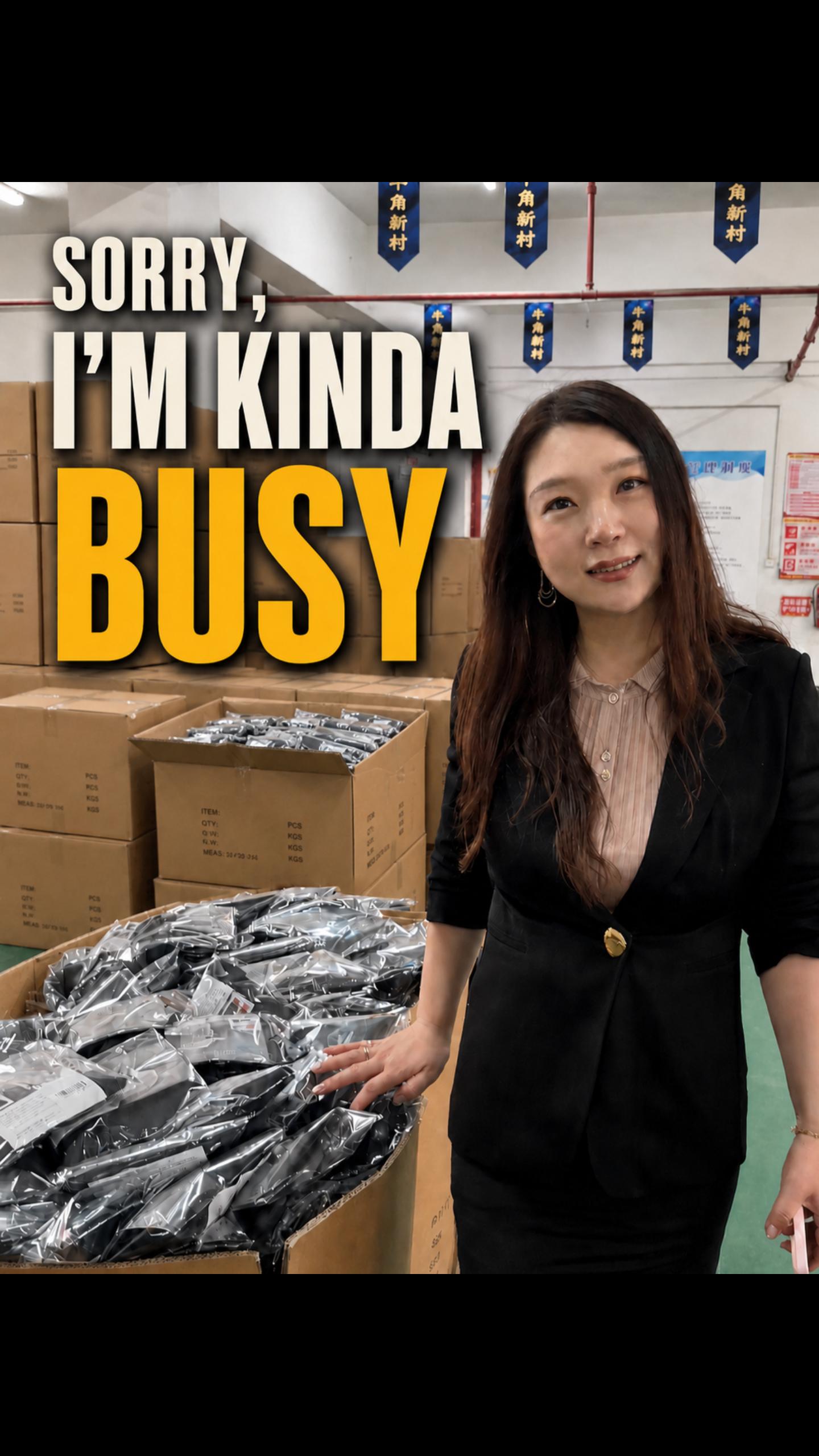
Why Do Sourcing Agents Use a Warehouse Before Shipping From China?
“Sorry, I can’t hear you. I’m kinda busy.”
Busy doing what?
Checking orders.
Reviewing finished products.
Packing shipments.
For international buyers, a sourcing warehouse in China may look like a place where cartons simply wait before shipment.
But in a well-managed sourcing process, the warehouse can play a much more important role.
It becomes a control point between:
Supplier
and
International shipment
Products can arrive from one or several suppliers, be received, organized, checked according to the agreed scope, prepared for consolidation, and then released for shipping.
So the real question is not:
“Why does a sourcing agent need a warehouse?”
It is:
“What can happen at the warehouse before my products leave China?”
Is a Sourcing Warehouse Just for Storage?
No.
Storage is only one possible function.
For a sourcing company, a local warehouse can also support:
Receiving supplier orders
Recording incoming cartons
Confirming quantities
Organizing products by buyer or SKU
Finished-product quality checks
Label and packaging confirmation
Repacking where required
Combining goods from multiple suppliers
Preparing orders for final shipment
Coordinating with freight providers
This creates an intermediate checkpoint before products leave China.
That checkpoint can be especially useful for overseas buyers who cannot personally inspect every order.
Why Not Ship Directly From the Factory?
Sometimes direct factory-to-forwarder shipping is perfectly practical.
For a simple order from one reliable supplier, adding another warehouse step may not always be necessary.
But sourcing becomes more complicated when the buyer has:
Several suppliers
Multiple SKUs
Different completion dates
Label requirements
Packaging requirements
Quality-control requirements
Consolidation needs
In those situations, sending everything through one sourcing warehouse can make the order easier to coordinate.
The warehouse becomes the place where different parts of the purchase come together.
The Warehouse Sits Between Purchasing and Logistics
Think of a typical sourcing process:
Buyer confirms order
↓
Supplier produces goods
↓
Supplier finishes packing
↓
Goods leave supplier
↓
Sourcing warehouse receives goods
↓
Order is checked and organized
↓
Multiple orders are consolidated if required
↓
Final shipment is prepared
↓
Freight forwarder collects goods
A warehouse can therefore connect two parts of the supply chain:
Purchasing
Products, suppliers, quantities, specifications and packaging.
Logistics
Cartons, volume, pickup, consolidation and international shipment.
This is why warehouse operations matter to sourcing—not only to shipping.
Step 1: Receiving the Goods
The first job is simple but important:
Did the supplier actually send what was expected?
When cartons arrive, the warehouse can record information such as:
Supplier
Buyer
Purchase order
Number of cartons
Product or SKU
Arrival date
This creates visibility.
If several suppliers are involved, it also helps answer:
Which orders have arrived and which are still missing?
Without centralized receiving, the buyer may have to coordinate several independent factory shipments at the same time.
Why Is Receiving Important?
Imagine a buyer has four suppliers.
Supplier A says:
“Shipped.”
Supplier B says:
“Ready.”
Supplier C says:
“Tomorrow.”
Supplier D says:
“Already delivered.”
But where are the goods actually?
A warehouse receiving record can turn those messages into physical status:
Supplier A — received
Supplier B — not received
Supplier C — waiting
Supplier D — received
For an international buyer, that difference is useful.
Supplier messages describe intention.
Warehouse receiving confirms physical arrival.
Step 2: Confirming Carton Quantity
Suppose the supplier's packing list says:
20 cartons
The warehouse receives:
18 cartons
That needs to be investigated before the international shipment continues.
Possible reasons might include:
Two cartons arriving later
Separate delivery
Supplier counting error
Transport issue
The warehouse does not automatically solve the cause.
But it can identify the mismatch early enough to ask the supplier.
This is better than discovering it after the shipment reaches another country.
Carton Count and Product Quantity Are Different
Receiving 20 cartons does not automatically prove every individual product quantity is correct.
There are two different levels:
Incoming Carton Confirmation
How many cartons arrived?
Product Quantity Check
How many finished units are inside?
Depending on the agreed service and order requirements, further quantity verification may be performed.
Buyers should define what level of checking they require rather than assume that warehouse receipt automatically equals a full inspection.
Step 3: Organizing Multiple SKUs
Modern sourcing orders often involve more than one item.
For example:
Product A — black
Product A — white
Product B — small
Product B — large
Product C — custom logo
Now the warehouse needs to keep the order organized.
This can include separation by:
SKU
Color
Size
Supplier
Customer order
Organization becomes especially important before consolidation.
Ten different products placed in one room are not yet a manageable shipment.
They need clear identification.
Step 4: Finished-Product Quality Checks
One of the most important warehouse functions can be checking finished goods before shipment.
At Youshow, our quality-control scope focuses on finished products.
Depending on the product and agreed requirements, checks may include:
Appearance and workmanship
Quantity
Dimensions
Basic functions
Labels
Packaging
Final pre-shipment confirmation
We do not position this as raw-material or semi-finished production inspection.
The warehouse provides a practical location where finished goods can be reviewed before they are released for international shipping.
Why Check Finished Products Again?
A supplier may already have its own internal QC.
That is useful.
But the buyer may still want an additional checkpoint based on the buyer's own requirements.
For example:
Does the product match the approved version?
Is the logo correct?
Are the correct colors present?
Is the quantity right?
Is the retail packaging correct?
Are the agreed labels applied?
The purpose is not to assume every supplier made a mistake.
It is to verify the finished order against the buyer's requirements before the shipment moves farther away.
A Warehouse Check Does Not Guarantee Zero Defects
This point is important.
No practical inspection process can promise that every future customer will receive a perfect product.
Inspection scope depends on factors such as:
Product type
Quantity
Inspection method
Agreed standards
Sampling approach where applicable
The purpose of warehouse quality control is to reduce avoidable sourcing risk and identify visible or agreed issues before shipment.
It is not a guarantee that defects can never exist.
Step 5: Checking Labels
Labels seem small.
They can create large problems.
Depending on the buyer and sales channel, products may require:
SKU labels
Barcodes
Product labels
Size labels
Color labels
Carton labels
Shipping marks
An incorrect label can cause problems even if the physical product is completely correct.
For example:
Correct product.
Wrong barcode.
Now the warehouse or fulfillment center may identify it as the wrong SKU.
That is why label confirmation can be part of final order preparation.
Step 6: Checking Packaging
Packaging serves several jobs.
It may need to:
Protect the product
Present the product
Carry required information
Fit logistics requirements
At the warehouse stage, buyers may need confirmation of details such as:
Correct individual packaging
Correct quantity per carton
Correct carton
Required labels
Packaging condition
Packaging should be checked before international shipment when it is part of the agreed order standard.
Once the shipment leaves China, correcting packaging usually becomes much more expensive.
Step 7: Repacking When Necessary
Sometimes products arrive from suppliers in packaging that is not ideal for the final shipment.
Depending on the project, repacking may be needed.
Possible reasons include:
Damaged outer cartons
Consolidation
Product organization
Buyer packaging requirements
Carton optimization
Repacking should not be done automatically.
It should have a clear operational reason.
Every additional handling step also creates:
Labor
Time
Cost
The objective is not to touch the goods as much as possible.
It is to make the shipment ready under the buyer's agreed requirements.
Step 8: Combining Orders From Multiple Suppliers
This is one of the biggest reasons buyers use a sourcing warehouse.
Imagine buying from four suppliers:
Supplier A → kitchen products
Supplier B → storage products
Supplier C → pet products
Supplier D → accessories
Without consolidation, each supplier may create a separate shipment.
With a sourcing warehouse:
Supplier A
Supplier B
Supplier C
Supplier D
↓
One warehouse
↓
Organize + prepare
↓
One consolidated shipment or coordinated shipping plan
This can simplify procurement and logistics management.
Whether it lowers freight costs depends on the actual products, shipment volume, weight and shipping method.
But operationally, the buyer gains one coordination point.
Why Is Consolidation Useful for Small Buyers?
Smaller importers often do not buy a full container of one product.
They may purchase:
100 units here
300 units there
Several cartons from another supplier
This creates a fragmented supply chain.
A warehouse allows smaller orders to be brought together before export.
That is especially relevant for buyers using:
Mixed-product sourcing
Small-batch sourcing
Multi-supplier orders
Flexible purchasing requires strong consolidation management.
Step 9: Waiting for the Last Supplier
There is also a tradeoff.
Suppose:
Supplier A arrives Monday.
Supplier B arrives Wednesday.
Supplier C arrives Friday.
Supplier D is delayed until the following Tuesday.
If all four need to ship together, the complete shipment may need to wait for Supplier D.
The warehouse should therefore help track:
Arrived
Pending
Delayed
Ready for consolidation
Then the buyer can decide whether to:
Wait
Split the shipment
Send urgent products first
Consolidation is useful, but it needs timeline management.
Step 10: Preparing the Final Shipment
Before goods are released to a freight provider, the sourcing team may need to confirm shipping information such as:
Total cartons
Carton dimensions
Gross weight
Total volume
Pickup address
Cargo readiness
Packing information
These numbers help turn the order into a logistics plan.
A supplier saying:
“Goods are ready.”
is not enough.
The logistics team needs physical shipment information.
Why Does Carton Information Matter?
Carton data may influence:
Freight quotation
Vehicle selection
Air freight
Ocean freight
Express shipping
Warehouse planning
For example:
20 cartons at one size and weight may produce a very different shipping result from 15 optimized cartons.
That is why warehouse operations and logistics planning are closely connected.
The Warehouse Can Identify Packing Opportunities
A warehouse may also reveal opportunities that are difficult to see from supplier quotations.
For example:
Excess empty space
Inefficient carton arrangement
Oversized outer cartons
Products that can be nested
Products that can be packed together
Not every shipment should be repacked.
But seeing the finished physical order allows the sourcing team to ask:
“Is this shipment using space efficiently?”
That can lead to practical packaging improvements.
Why Is This Better Than Only Looking at Supplier Photos?
Supplier photos can show:
Product
Packaging
Cartons
But they cannot always tell you:
Exactly what arrived
How several suppliers' goods fit together
Whether labels match
Whether cartons are damaged
How much warehouse space the total order uses
Physical receiving creates another layer of information.
For overseas buyers, that layer can be valuable.
What Does “Checking Orders” Actually Mean?
In a sourcing warehouse, “checking orders” can involve several different jobs.
For example:
Order Status
Which supplier has delivered?
Quantity
How many cartons or units are present?
Product
Is the correct SKU present?
Quality
Do agreed finished-product details meet the confirmed standard?
Labels
Are required labels correct?
Packaging
Is the order packed according to requirements?
Shipment
Is the order ready to move to the next stage?
So when a sourcing agent says:
“I'm checking orders.”
it can represent an important part of supply-chain control.
Warehouse Work Is Not Very Glamorous
Much sourcing content focuses on:
Trade shows
New products
Factories
Wholesale markets
Those are visually interesting.
But a large part of procurement happens after the exciting product discovery stage.
Someone still needs to manage:
Cartons
SKUs
Labels
Quantities
Packaging
Supplier arrivals
Shipment preparation
These tasks are less glamorous.
They are also where many preventable order problems can be discovered.
Why Does a Local Team Matter?
An overseas buyer may be thousands of kilometers away.
If the supplier says:
“Everything is ready.”
the buyer has limited ways to verify the physical goods remotely.
A local sourcing team can act as an operational bridge.
Depending on the service scope, the team can:
Receive goods
See the cartons
Review finished products
Communicate with suppliers
Coordinate corrections
Prepare consolidated shipments
This is one of the practical differences between simply finding a supplier online and managing a sourcing process locally.
Can Buyers Use a Third-Party Warehouse Instead?
Yes.
There is no rule that the warehouse must belong to the sourcing agent.
Depending on the supply chain, buyers may use:
Supplier warehouses
Sourcing-company warehouses
Freight-forwarder warehouses
Third-party logistics warehouses
The right choice depends on what needs to happen at the location.
If the only requirement is:
receive and ship cartons
a logistics warehouse may be sufficient.
If the buyer needs:
Supplier coordination
Product checking
Mixed-SKU organization
Repacking
Sourcing follow-up
a sourcing warehouse may offer a different type of support.
Warehouse and Freight Forwarder Are Not the Same Thing
Their responsibilities can overlap, but their primary roles are different.
A sourcing team typically focuses more on:
Product
Supplier
Order
Quality requirements
A freight forwarder typically focuses more on:
Transportation
Freight booking
Export shipment
Logistics documentation
Some providers offer both types of services.
But buyers should understand who is responsible for each step.
What Should Buyers Ask a Sourcing Company About Its Warehouse?
Useful questions include:
Receiving
Can you receive products from multiple suppliers?
Organization
How are different buyers and SKUs separated?
QC
What finished-product checks can you perform?
Packaging
Can labels or packaging be checked?
Consolidation
Can several supplier orders be combined?
Repacking
Can cartons be repacked when necessary?
Shipping
Can the warehouse coordinate pickup with the freight provider?
These questions tell you more than simply asking:
“Do you have a warehouse?”
A Large Warehouse Does Not Automatically Mean Better Sourcing
Warehouse size by itself is not the main point.
A large building is useful only when the processes inside it are organized.
Buyers should care about:
Receiving process
Order identification
Product separation
Checking process
Issue reporting
Shipment coordination
The warehouse is infrastructure.
The operational system creates the value.
Why Does Issue Reporting Matter?
Suppose the warehouse discovers:
Wrong logo
Missing units
Incorrect color
Damaged packaging
The next question is:
What happens now?
A useful sourcing process should include:
Record the problem.
Take relevant photos or information.
Confirm affected quantity.
Contact the supplier.
Discuss correction or replacement.
Update the buyer when needed.
Reconfirm before shipment.
Finding an issue is only half the job.
The other half is resolving it.
Problems Are Easier to Handle Before International Shipment
Imagine discovering an incorrect label while the goods are still in Yiwu.
The supplier may be relatively close.
Replacement labels can potentially be coordinated.
Now imagine discovering the same issue after the goods arrive in the United States.
Correcting it can require:
Local labor
Repacking
Relabeling
Extra warehouse fees
Additional time
This is why an in-China control point can have practical value.
The purpose is to catch resolvable issues while the supply chain still has more options.
How Does a Warehouse Help With Repeat Orders?
For repeat orders, the warehouse can become a comparison point.
The sourcing team may have:
Previous order records
Approved samples
Packaging references
Label references
Then the new finished batch can be compared against the agreed standard.
This helps answer:
“Is the repeat order still the same product?”
Consistency is especially important for buyers selling the same SKU over time.
How Does a Warehouse Help With Small-Batch Sourcing?
Small-batch sourcing often involves multiple suppliers.
One supplier may provide:
100 PCS
another:
200 PCS
another:
50 PCS
The quantities are manageable individually, but the logistics become fragmented.
A local warehouse can bring these smaller purchases together.
This supports a sourcing model based on:
test → learn → reorder
rather than requiring every initial product to fill a large standalone shipment.
How Does a Warehouse Help Ecommerce Sellers?
Ecommerce buyers may have additional order requirements such as:
SKU labels
Barcodes
Product packaging
Bundle configuration
Carton identification
A sourcing warehouse can provide a checkpoint before goods move to the final fulfillment destination.
The exact preparation requirements depend on the sales platform and destination warehouse, so they should always be confirmed for the specific shipment.
How Does a Warehouse Help Wholesalers?
Wholesalers may order many SKUs from several factories.
Their biggest challenge is often not finding one product.
It is coordinating the complete purchase.
A warehouse can help centralize:
Receiving
SKU organization
Cartons
Consolidation
Shipment preparation
This reduces the number of independent supplier shipments the buyer needs to manage.
Should Every Order Go Through a Warehouse?
No.
Adding warehouse handling should have a purpose.
Direct shipment may make sense when:
One supplier
Simple product
No consolidation
No additional checking required
Supplier packaging already meets requirements
Warehouse handling may be more valuable when:
Multiple suppliers
Multiple SKUs
Finished-product checks
Label confirmation
Packaging coordination
Consolidation
Repacking
More complex order management
The supply chain should be designed around the order.
What Information Should Buyers Send Before Goods Arrive?
A useful warehouse instruction can include:
Supplier:
Supplier A
Product:
SKU 001
Expected quantity:
500 PCS
Expected cartons:
10 cartons
Color / size breakdown:
As confirmed
QC requirement:
Specified finished-product checks
Labels:
Approved file
Packaging:
Confirmed version
Next step:
Consolidate with Supplier B
This gives the warehouse a clear standard.
Without instructions, the warehouse can only confirm what physically arrived—not whether it matches the buyer's complete expectation.
Build a Warehouse Checklist
A simple checklist can include:
Receiving
Supplier confirmed
Cartons received
Arrival recorded
Product
SKU identified
Quantity checked according to agreed scope
Finished-product checks completed where required
Packaging
Individual packaging confirmed
Labels confirmed
Cartons reviewed
Consolidation
Other supplier orders received
Missing shipments identified
Shipping
Total cartons confirmed
Dimensions / weight available
Pickup date confirmed
This creates a repeatable process.
Warehouse Status Should Be Clear
A useful status system can be simple:
WAITING FOR SUPPLIER
↓
RECEIVED
↓
CHECKING
↓
ISSUE FOUND / PENDING
or
APPROVED
↓
READY FOR CONSOLIDATION
↓
READY FOR PICKUP
This gives buyers more useful information than:
“Your order is in our warehouse.”
Physical location alone does not tell you whether the order is ready.
What Does “Ready to Ship” Actually Mean?
Before a shipment is treated as ready, confirm that the required steps are complete.
Depending on the order:
Goods received
Quantity confirmed
Finished-product checks completed
Issues resolved
Labels confirmed
Packaging confirmed
Consolidation completed
Carton data available
Logistics pickup arranged
Only then does:
“Ready to ship.”
become operationally meaningful.
A Better China Sourcing Workflow
Instead of:
Supplier → International shipment
a more controlled multi-supplier workflow may look like:
Supplier A
Supplier B
Supplier C
↓
Yiwu sourcing warehouse
↓
Receive
↓
Identify orders
↓
Check finished products
↓
Confirm packaging / labels
↓
Resolve issues
↓
Consolidate
↓
Confirm final carton data
↓
Release to freight provider
↓
International shipment
The warehouse acts as the bridge between sourcing and logistics.
Why This Matters More Than It Looks
A warehouse video may not look exciting.
There are cartons.
People are checking goods.
Someone is packing an order.
But those ordinary actions represent an important part of international procurement.
Finding a product is only the beginning.
The buyer still needs that product to arrive as:
The correct item
The correct quantity
The confirmed finished standard
The correct packaging
A manageable shipment
That is where sourcing operations become visible.
The Best Warehouse Result Is Often Boring
If everything works correctly, the buyer may never see dramatic problems.
Products arrive.
Checks are completed.
Cartons are organized.
The shipment leaves.
Nothing goes wrong.
That can make warehouse work look unremarkable.
But predictable sourcing is often built from exactly these ordinary steps.
The goal is not drama.
It is control.
How Can a Sourcing Company Help?
A sourcing company can coordinate the order from supplier handover to international shipment.
Depending on the project, support may include:
Product sourcing
Supplier coordination
Production follow-up
Warehouse receiving
Finished-product quality inspection
Quantity confirmation
Packaging and label checks
Repacking where needed
Multi-supplier consolidation
Shipping preparation
Worldwide shipping coordination
These services help overseas buyers manage several physical stages of the sourcing process without needing to be present in China for every order.
About Youshow
Youshow is a Yiwu-based sourcing company helping global buyers source and manage products from China.
Our services include:
Product sourcing
Supplier comparison and evaluation
Sample collection
Production follow-up
Yiwu warehouse receiving
Finished-product quality inspection
Packaging and label confirmation
Small-quantity and mixed-product sourcing
Multi-supplier order consolidation
OEM and ODM customization
Export certification support
Worldwide shipping coordination
We help importers, wholesalers, retailers, Amazon sellers, and ecommerce businesses simplify procurement and reduce sourcing risks.
Our Yiwu warehouse gives our team a physical point where supplier orders can be received, organized, checked according to the agreed finished-product scope, consolidated when required, and prepared for the next logistics stage.
So when we say:
“I'm kinda busy checking orders.”
the work behind that sentence may include the part of sourcing buyers rarely see:
making sure the physical goods are actually ready to move forward.
Because sourcing does not end when the supplier says:
“Finished.”
It ends when the right products are prepared to reach the buyer.

