
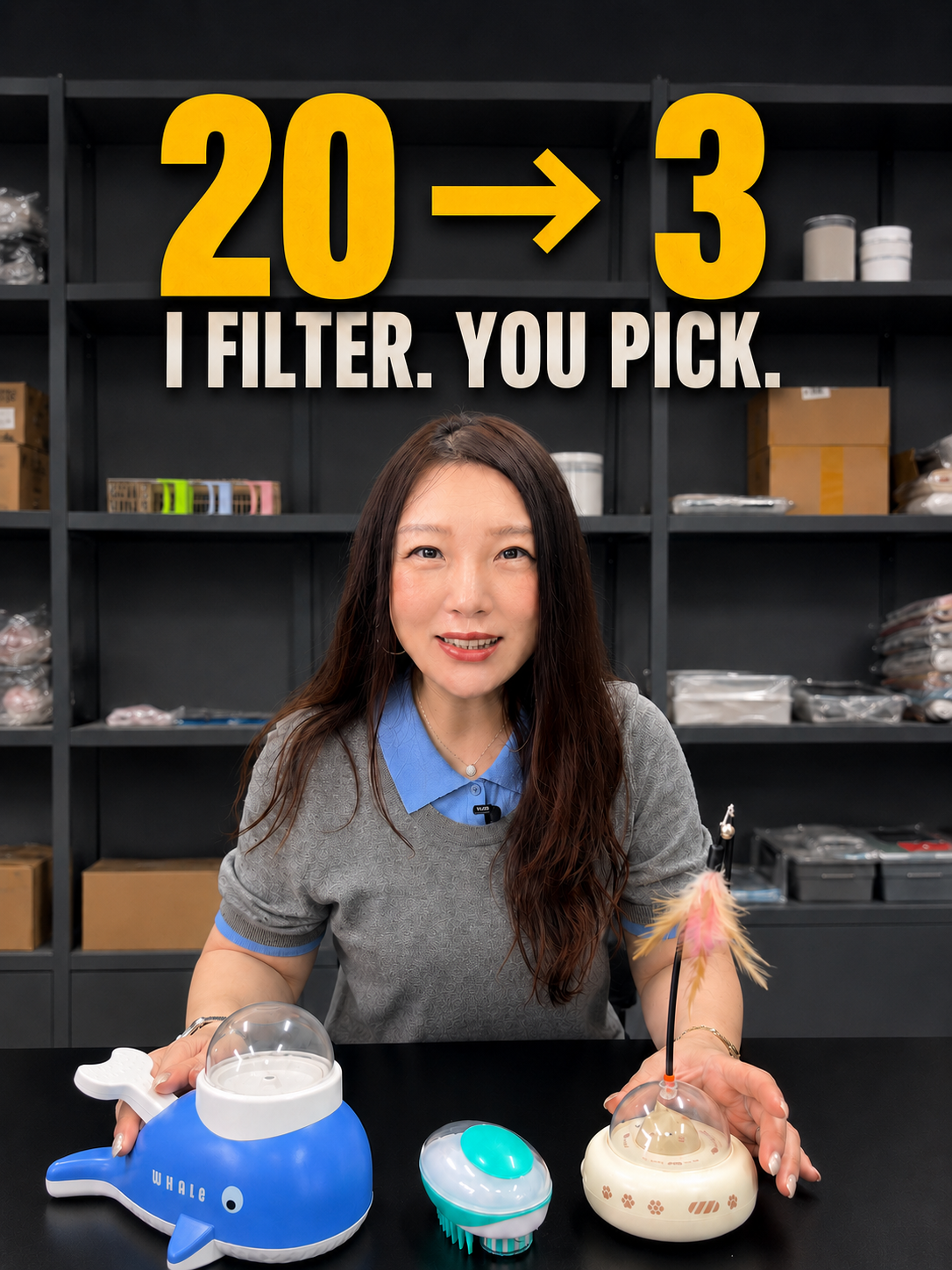
20 Products to 3: How a Sourcing Agent Should Shortlist Products for Buyers
Your sourcing agent sends you 20 product links.
Would you actually open every one?
Maybe.
But would you carefully compare all 20?
Probably not.
This is a common sourcing problem.
Buyers ask for product ideas, and the sourcing team responds by sending:
20 links
30 photos
50 supplier catalogs
Technically, the sourcing agent has provided a lot of information.
But the buyer still has to do all the real filtering.
A better process is different:
Find broadly → Filter first → Send only the strongest options
For example:
20 products
↓
Review buyer fit
↓
Remove irrelevant options
↓
Keep the best 3
↓
Buyer makes the final decision
The sourcing agent should not decide what the buyer must purchase.
But the sourcing agent can reduce the noise around that decision.
More Product Options Are Not Always Better
It sounds useful to receive 20 options instead of 3.
More choice should mean a better chance of finding the right product.
In practice, too many options can create another problem:
Decision overload.
The buyer now needs to compare:
Product
Price
Style
Supplier
MOQ
Packaging
Market fit
Sales potential
across dozens of products.
And many of those products may never have been suitable in the first place.
The sourcing team's first job should therefore be:
Remove obviously weak or irrelevant options before the buyer spends time reviewing them.
What Is Product Shortlisting?
Product shortlisting means reducing a large group of possible products into a smaller group that better matches the buyer's requirements.
For example:
Initial search: 20 products
After screening:
Shortlist: 3 products
The buyer still chooses the final product.
But instead of choosing from random products, they choose from a more relevant set.
A good shortlist answers:
Why are these products worth the buyer's attention?
Why Should a Sourcing Agent Filter Products First?
International buyers usually have limited time.
They may already be managing:
Sales
Marketing
Customers
Inventory
Logistics
Existing suppliers
They do not need another person to send them hundreds of links.
They need useful choices.
That means the sourcing agent should understand enough about the buyer's business to remove obvious mismatches.
Start With What the Buyer Already Sells
In the video, the buyer sells:
Pet supplies.
That immediately gives us a filtering rule.
A product should make sense alongside the buyer's existing assortment.
Suppose we find:
Product A
A decorative animal-shaped object
It looks cute.
But its primary purpose is décor.
Product B
A practical pet accessory
It fits the customer's existing pet-product assortment.
Which one should be prioritized?
For this buyer, Product B is much more relevant.
This does not mean Product A is a bad product.
It simply may be wrong for this particular customer.
A Good Product Can Still Be the Wrong Product
This is one of the most important product-sourcing principles.
A product can be:
Attractive
Well made
Cheap
Trending
Popular with another buyer
and still be unsuitable for your business.
Why?
Because the real question is not:
“Is this a good product?”
It is:
“Is this a good product for this buyer?”
That distinction changes the way products should be sourced.
Product Fit Comes Before Product Quantity
A sourcing agent may be able to find 100 products in one category.
That does not mean the buyer needs to see 100.
The first objective should be relevance.
Ask:
Does it fit the buyer's category?
Does it fit their customer?
Does it fit their selling price?
Does it fit their sales channel?
Does it fit the way they currently merchandise products?
If not, remove it.
Step 1: Understand the Buyer's Existing Product Line
Before searching for new products, look at what the buyer already sells.
Useful information can include:
Product categories
Price range
Customer type
Product style
Existing best sellers
Brand positioning
For example, a pet store selling practical daily-use accessories may be better served by:
Grooming products
Feeding accessories
Travel accessories
Toys
Cleaning products
than by unrelated decorative items.
The product search should begin with the buyer's business—not the supplier catalog.
Step 2: Understand the Target Customer
Two businesses may both sell pet products but serve completely different customers.
Buyer A
Budget-focused mass-market pet products
Buyer B
Premium design-focused pet accessories
Buyer C
Outdoor and travel products for dog owners
All three belong to the pet category.
But the same new product may not suit all three.
That means product shortlisting needs to consider:
Who actually buys from this business?
Step 3: Look at the Existing Price Range
Suppose the buyer normally sells products for:
$10–$25
Now the sourcing agent finds a product that would probably need to retail for:
$80
It may be a good product.
But it would introduce a very different customer decision.
That does not mean it should automatically be rejected.
But the sourcing agent should know that it falls outside the buyer's normal range.
Relevant sourcing considers the commercial context.
Step 4: Match the Product to the Sales Channel
A product that works well for one channel may perform poorly in another.
For example:
Physical Retail
May value:
Shelf presentation
Packaging
Impulse appeal
Ecommerce
May care more about:
Shipping size
Product demonstration
Reviews
Fulfillment economics
Wholesale
May prioritize:
Carton quantities
Margin
Reorder potential
Broad retailer appeal
So a product shortlist should also consider where the buyer plans to sell.
Step 5: Ask Whether the Product Extends the Existing Assortment
A strong new product often makes sense beside something the buyer already sells.
For example:
Buyer already sells:
Pet bowls
Possible adjacent products:
Feeding mats
Travel bowls
Food scoops
Water bottles
The new product extends the same customer need.
This is often easier to sell than introducing something completely unrelated.
Use the “Would This Customer Buy It?” Test
A simple product-filtering question is:
Would the same customer who buys the buyer's existing products reasonably buy this too?
If yes, the product may fit.
If no, ask why it belongs in the shortlist.
This is not a perfect rule.
Businesses sometimes intentionally enter new categories.
But it is an excellent first filter.
Product Sourcing Should Not Be Random Browsing
Yiwu markets, Chinese supplier catalogs, trade shows, and sourcing platforms contain enormous numbers of products.
Without a clear filter, product sourcing quickly becomes:
Scroll → Save → Send
That produces quantity.
It does not necessarily produce insight.
A professional sourcing process should look more like:
Search → Compare → Filter → Explain
The buyer should receive fewer products with better reasons behind them.
What Should Be Removed From the Shortlist?
Several types of products may be filtered out early.
Wrong Category
The product does not fit the buyer's store.
Wrong Customer
The product targets a different type of consumer.
Wrong Price Level
The likely selling economics do not fit.
Wrong Channel
Packaging, size, or positioning conflicts with the buyer's sales model.
Duplicate Options
Several products offer essentially the same idea.
Weak Differentiation
The product adds little to what the buyer already sells.
Impractical Supply Conditions
MOQ or lead time may make the option unrealistic.
Removing these products makes the final shortlist stronger.
Not Every Cute Product Belongs in the Store
This is exactly what the video illustrates.
A product may create the first reaction:
“That's cute.”
But then ask:
What is it actually for?
If the answer is mainly:
Décor
while the buyer specializes in functional pet supplies, the product may not fit the store.
A sourcing agent should be willing to say:
Interesting product, wrong buyer.
That is more useful than sending every visually attractive item.
Do Not Confuse “Pet-Shaped” With “Pet Product”
This applies far beyond pets.
For example:
A product with a dog shape is not automatically a pet product.
A strawberry-shaped product is not automatically a food product.
A sports-themed decoration is not automatically sporting equipment.
Category should be based on:
How the customer uses the product
rather than only:
What the product looks like.
This prevents visual novelty from overriding commercial logic.
Function Can Be a Better Filter Than Appearance
Suppose a buyer sells pet-care products.
Product A:
Looks very pet-themed but is decorative.
Product B:
Looks simpler but performs a useful pet-care function.
For this particular buyer, Product B may deserve higher priority.
This does not mean functional products always beat decorative ones.
It means the sourcing agent should follow the buyer's positioning.
How Many Products Should Be on a Shortlist?
There is no universal number.
Three works well in the video because it gives the buyer:
Choice
Comparison
Less overload
In other projects, a shortlist may contain:
3 products
5 products
8 products
The goal is not to hit a fixed number.
The goal is to reduce the list until every remaining option has a reason to be there.
A shortlist of five relevant products is more useful than 30 random ones.
Should the Sourcing Agent Make the Final Choice?
Usually, no.
The sourcing agent can provide:
Product information
Supplier information
Price
MOQ
Lead time
Packaging
Samples
Market-fit observations
But the buyer knows important things the sourcing agent may not know:
Customer behavior
Brand strategy
Marketing plan
Sales data
Margin targets
So the ideal division is:
Sourcing agent filters and explains.
Buyer makes the commercial decision.
“I Filter, You Pick”
That is the core logic of the video.
The sourcing agent should reduce:
20 → 3
Then the buyer chooses:
3 → 1
This is a much healthier division of work than either extreme.
Bad Extreme 1
Agent sends 20 random products and does no filtering.
Bad Extreme 2
Agent decides one product is definitely right and gives the buyer no choice.
Better Approach
Agent creates a relevant shortlist.
Buyer chooses from the shortlist.
What Information Should Be Included With the Final Three?
A product shortlist should not consist only of three photos.
Useful information can include:
Product
What is it and what problem does it solve?
Reason for Recommendation
Why does it fit the buyer?
Approximate Price
Based on the relevant quantity.
MOQ
Including whether it is per SKU, color, or total where applicable.
Stock
Ready stock or new production?
Lead Time
When could the product realistically be ready?
Packaging
What is currently included?
Supplier
What type of supplier is providing it?
Now the buyer can compare commercial options, not just images.
Example of a Better Shortlist
Instead of sending:
Product A.jpg
Product B.jpg
Product C.jpg
send:
Option A — Portable Pet Water Bottle
Why it fits: Buyer already sells travel pet products.
MOQ: Confirmed with supplier
Price: Based on buyer quantity
Stock: Available / production required
Key point: Compact, practical extension to existing range
Option B — Grooming Tool
Why it fits: Daily-use pet-care category
MOQ: Confirmed
Price: Confirmed
Key point: Function is easy for customer to understand
Option C — Interactive Toy
Why it fits: Adds another practical pet category without moving outside current customer base
Now the buyer understands why these products made the shortlist.
Should Price Be Used as the First Filter?
Sometimes, but not always.
If the buyer gives a strict target price, then products far outside that range can be removed early.
For example:
Target purchase price: Under $3
A $12 sourcing option may not deserve further review.
But price should not be the only filter.
A cheap product that does not fit the customer is still a poor recommendation.
Use Hard Filters and Soft Filters
A practical sourcing shortlist can use two types of filters.
Hard Filters
Requirements the product must meet.
Examples:
Maximum price
Required category
Required deadline
Required certification
Maximum MOQ
If it fails, remove it.
Soft Filters
Factors that help rank relevance.
Examples:
Fits existing product line
Visually strong
Easy to explain
Good bundle potential
Suitable for current customers
This creates a more consistent selection process.
First Filter: Can the Buyer Actually Buy It?
Before recommending a product, confirm that it is commercially possible.
Ask:
Is the MOQ workable?
Is the price reasonable?
Is the product available?
Can the supplier meet the deadline?
Can the required customization be done?
A beautiful product that cannot be ordered under the buyer's conditions should not occupy one of the final three slots.
Second Filter: Does It Fit the Buyer?
Now ask:
Same customer?
Same category?
Appropriate price level?
Suitable channel?
Logical extension to current assortment?
This is where sourcing becomes more personalized.
Third Filter: Is It Worth Testing?
Finally ask whether the product provides a useful reason to test.
That could be:
New function
Better price point
New use case
Different customer need
Bundle opportunity
Easier shipping
Seasonal opportunity
The product should add something to the buyer's assortment.
Shortlisting Can Reduce Sample Costs
Suppose the buyer requests samples for all 20 products.
That can create:
20 sample charges
20 domestic deliveries
More international shipping
More time reviewing samples
If the sourcing team first narrows the list to three strong options, sampling becomes more efficient.
The workflow becomes:
20 digital candidates
↓
3 shortlisted products
↓
3 physical samples
↓
1 final selection
This can reduce unnecessary sample handling.
Shortlisting Can Also Save Buyer Time
Time is part of sourcing cost.
Suppose reviewing each product properly takes five minutes.
20 products:
100 minutes
3 products:
15 minutes
The sourcing agent has shifted part of the research workload away from the buyer.
That is one of the legitimate values of a sourcing service.
But Filtering Should Be Transparent
There is one risk with shortlisting:
The agent may remove an option the buyer would actually have liked.
That is why the filtering criteria should be understandable.
For example:
Removed because:
Decorative rather than functional pet product
MOQ too high
Outside target price
Too similar to existing item
Lead time misses deadline
Now the buyer can understand the reasoning.
The goal is not to hide information.
It is to organize it.
What If the Buyer Wants More Choices?
Then provide more.
A shortlist is a tool, not a restriction.
Some experienced buyers may specifically request:
“Send me everything you find.”
That can make sense when they have an internal buying team.
Other buyers may prefer:
“Only send me the best three.”
The sourcing process should match how the buyer wants to work.
New Buyers Usually Benefit From More Filtering
A first-time importer may not know:
Which specifications matter
Which MOQ is realistic
Which supplier questions to ask
Which products fit their shipping model
For these buyers, a carefully explained shortlist can be especially useful.
It reduces information overload while still leaving the final decision with the buyer.
Experienced Buyers May Want Raw Market Information
A larger wholesaler may already have:
Buyers
Merchandising team
Market data
Strong category knowledge
They may want a wider product scan.
In that case, the sourcing agent can provide:
Broad market scan
followed by:
Recommended shortlist
This gives both breadth and judgment.
How Should Buyers Brief a Sourcing Agent?
The better the input, the better the shortlist.
Instead of:
“Send me some pet products.”
provide:
Current category: Pet supplies
Target market: United States
Sales channel: Ecommerce / retail
Target purchase price: $2–$5
Preferred MOQ: Under 500 PCS
Customer: Everyday pet owners
Products already sold: Feeding, grooming, travel
Goal: Add 3–5 new products
Now the sourcing agent has meaningful filters.
Send Your Existing Store or Catalog
One of the easiest ways to help a sourcing team understand your business is to share:
Website
Product catalog
Store screenshots
Existing listings
Current best sellers
This gives context that a single product request cannot provide.
The sourcing agent can see:
What does this buyer already look like as a business?
Then the search becomes more relevant.
Use Previous Sales Data Where Possible
If you know that:
Travel products perform well
Decorative products perform poorly
Customers prefer products under $20
Blue sells better than pink
tell the sourcing team.
Real customer data is a stronger filter than personal taste.
The sourcing agent should not guess what the buyer's customers want when the buyer already has evidence.
Product Selection Should Improve Over Time
A sourcing relationship should become smarter with repeated projects.
After several sourcing rounds, the team can learn:
Which recommendations the buyer chooses
Which they reject
Which categories perform well
Which price levels work
Which supplier conditions matter most
Then future searches can become more focused.
Ideally:
20 → 3
eventually becomes:
10 → 3
because the sourcing team understands the buyer better from the beginning.
Why Supplier Catalog Dumping Is Not Enough
A supplier may send a 200-page catalog.
Forwarding that PDF to the buyer is easy.
But that is not really product curation.
A sourcing agent should add value between:
Supplier catalog
and
Buyer decision.
That value may include:
Filtering
Comparing
Context
Supplier follow-up
Price confirmation
MOQ confirmation
Sample evaluation
Otherwise, the buyer is still doing most of the sourcing work.
Product Discovery vs. Product Recommendation
These are two separate tasks.
Discovery
Find possible products.
This produces:
20 options
Recommendation
Evaluate which options deserve further attention.
This produces:
3 options
Both matter.
But recommendation requires understanding the buyer.
Search alone does not.
Why Local Market Access Is Not Enough
Being in Yiwu gives access to a huge number of suppliers and products.
But access itself does not create better purchasing decisions.
A sourcing agent can walk through thousands of products.
If every product is sent to the buyer, the local advantage becomes information overload.
The local advantage becomes more useful when it is combined with:
Buyer understanding
Filtering
Supplier comparison
Practical sourcing judgment
How Can Youshow Filter Product Options?
Depending on the buyer's project, the initial screening can consider:
Product category
Existing assortment
Buyer requirements
Target price
MOQ
Stock availability
Lead time
Sales channel
Packaging
Supplier information
After the first digital shortlist, buyers can decide which products deserve:
Supplier comparison
Detailed quotation
Sample collection
Further evaluation
This keeps the process efficient.
What Happens After the Buyer Picks the Final Three?
Shortlisting is only one stage.
A practical next process can be:
20 products discovered
↓
3 products shortlisted
↓
Detailed supplier information collected
↓
Quotations compared
↓
Samples requested
↓
Product and supplier evaluated
↓
1–2 products selected
↓
Order terms confirmed
↓
Order placed
The shortlist reduces the search space.
It does not replace proper sourcing due diligence.
Do Not Choose From Photos Alone
Once the shortlist becomes serious, buyers may need more information.
Depending on the product, evaluate:
Size
Material
Basic function
Packaging
Sample quality
Supplier terms
A product can look perfect in a photo and perform poorly in reality.
The shortlist tells you:
What deserves further investigation.
It does not automatically mean:
Approved for bulk order.
What Should a Sourcing Agent Not Do?
Avoid these patterns:
Send Everything
“Here are 50 links. You choose.”
Choose Based Only on Personal Taste
“I like this one, so you should sell it.”
Recommend Only the Cheapest Product
Price alone does not determine product fit.
Recommend Every Supplier's “Best Seller”
Best seller where?
For which market?
For which customer?
Make Sales Guarantees
No sourcing agent can reliably promise:
“This product will definitely sell.”
The sourcing agent can provide better inputs.
The market still decides the result.
What Is the Real Value of Product Curation?
The value is not:
“We found fewer products.”
The value is:
“We removed products that did not deserve your time.”
That is a major difference.
A good sourcing shortlist should help the buyer spend attention on:
More relevant products
More realistic supplier options
More useful comparisons
The buyer's time is a sourcing resource too.
A Simple 20-to-3 Framework
Use this process:
20 — Discovery
Find broadly.
Do not eliminate interesting options too early.
10 — Basic Commercial Filter
Remove options with obvious problems:
Wrong category
Wrong price
Wrong MOQ
Wrong timing
5 — Buyer-Fit Filter
Ask:
Fits customer?
Fits store?
Fits channel?
Adds something useful?
3 — Final Shortlist
Provide the best remaining options with clear reasons.
1 — Buyer Decision
The buyer selects which product deserves the next step.
This keeps the sourcing agent useful without replacing the buyer's judgment.
Conclusion
Twenty product links may look like more sourcing work.
But if only three are relevant, the buyer should not need to discover that alone.
A stronger sourcing process is:
Search broadly.
Filter intelligently.
Explain the shortlist.
Let the buyer decide.
If the buyer sells pet supplies, begin with products that actually fit that business.
If something is mainly décor, say so.
If another product clearly fits the customer's existing range, prioritize it.
The sourcing agent's job is not to make the buyer's decision.
It is to make the decision easier.
20 products found.
3 products worth reviewing.
You choose from the best three.
About Youshow
Youshow is a Yiwu-based sourcing company helping global buyers source and manage products from China.
Our services include:
Product sourcing
Product research and shortlisting
Supplier comparison and evaluation
Target-price and MOQ confirmation
Sample collection
Small-quantity and mixed-product sourcing
Finished-product quality inspection
OEM and ODM customization
Packaging coordination
Multi-supplier order consolidation
Export certification support
Worldwide shipping coordination
We help importers, wholesalers, retailers, Amazon sellers, and ecommerce businesses simplify procurement and reduce sourcing risks.
When buyers ask us to find new products, our role is not simply to forward every supplier link we find.
We can first review factors such as the buyer's existing product line, sourcing requirements, price range, MOQ, supplier conditions, and intended market, then narrow the initial search into a more relevant shortlist for the buyer to evaluate.
Because good sourcing is not about giving buyers the most options.
It is about helping them spend their time on the right options.

