
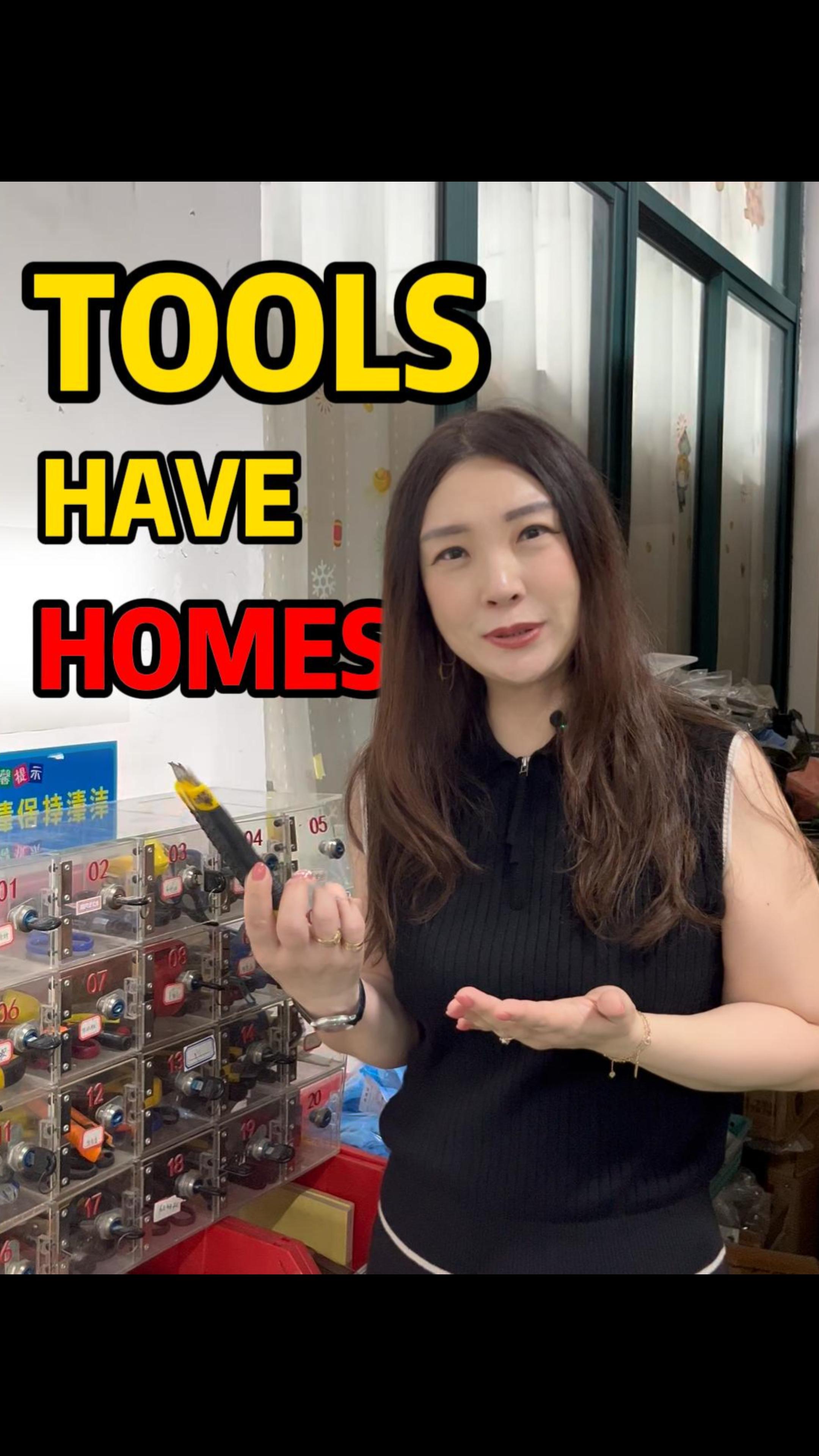
How Warehouse Tool Control Helps Prevent Shipping Problems
Warehouse management is not only about cartons, inventory, and large shipments.
Small tools also matter.
Utility knives, scissors, tape cutters, markers, rulers, and other tools are used every day during receiving, checking, packing, labeling, and shipment preparation.
If these tools are not controlled properly, they can be misplaced, mixed into products, left inside cartons, or cause damage during warehouse operations.
That is why every tool should have a designated place.
Why Does Tool Control Matter in a Sourcing Warehouse?
Warehouse teams use small tools throughout the day.
They may be used to:
- Open supplier cartons
- Check product packaging
- Measure products or cartons
- Apply labels
- Mark shipment information
- Repack products
- Seal export cartons
- Prepare orders for delivery
Because these tools are small and used frequently, they can easily be left on a worktable, placed inside an open carton, or mixed with products.
A simple tool-management system helps reduce these avoidable risks.
What Can Happen When Tools Are Not Controlled?
A missing warehouse tool may appear to be a minor issue.
However, it can create several problems.
1. A Tool May Be Packed With the Goods
A small knife, marker, ruler, or tape cutter can accidentally remain inside a carton during packing.
This may lead to:
- A foreign object reaching the buyer
- Product or packaging damage
- Safety concerns
- Customer complaints
- Additional warehouse checks
- Shipment delays while the tool is located
The problem becomes more serious when the carton has already been sealed or shipped.
2. Products May Be Damaged
Loose tools can scratch, puncture, stain, or deform products and packaging.
For example:
- A utility knife may cut product packaging
- A marker may stain a product surface
- Metal tools may scratch finished goods
- Scissors may damage polybags or retail boxes
- Measuring tools may be left underneath fragile products
Controlling the tools helps protect finished products during handling and packing.
3. Packing Work May Be Interrupted
When tools do not have fixed locations, employees may spend time searching for them.
This can slow down:
- Product checking
- Labeling
- Repacking
- Carton sealing
- Shipment preparation
A clear tool-storage system makes everyday warehouse work more organized and predictable.
4. Responsibility Becomes Unclear
If everyone can leave tools anywhere, it becomes difficult to identify:
- Who used the tool
- Where it was last used
- Whether it was returned
- Whether it may be inside an unfinished carton
- Whether the tool is missing or damaged
Designated tool positions make it easier for the team to notice a missing item immediately.
What Does a Basic Warehouse Tool-Control System Include?
Tool control does not need to be complicated.
A practical system can include several simple steps.
1. Give Every Tool a Fixed Position
Each tool should have its own clearly marked location.
This may include:
- Labeled hooks
- Numbered compartments
- Tool boards
- Storage boxes
- Assigned drawers
- Designated workstations
When the tool is removed, the empty position becomes visible.
This helps employees notice immediately when something has not been returned.
2. Separate Tools by Type
Different tools should be stored in separate positions.
For example:
- Utility knives
- Scissors
- Markers
- Measuring tapes
- Rulers
- Screwdrivers
- Tape dispensers
This makes it easier to count, locate, and return each item.
It also prevents sharp tools from being mixed with general office or packing supplies.
3. Return Tools After Every Task
Tools should not remain on products, cartons, pallets, or packing tables after the task is complete.
After use, employees should return them to their designated positions.
This is especially important before:
- Closing a carton
- Moving products to another area
- Changing packing tasks
- Leaving the workstation
- Finishing work for the day
A regular return habit reduces the possibility of tools being forgotten inside an order.
4. Check the Tool Board Before Leaving
Before employees finish their work, the tool-storage area should be checked.
The team should confirm:
- Every assigned tool is present
- Tools are in the correct position
- No tool is damaged
- No sharp part is missing
- No tool has been left near the goods
- Any missing item is investigated
If one position is empty, the team should locate the tool before the warehouse activity is closed.
5. Keep Loose Tools Away From Open Goods
Open cartons and unpacked products create a higher risk of accidental mixing.
Employees should avoid placing tools:
- Inside cartons
- On top of products
- Between layers of goods
- Inside packaging materials
- On pallets waiting to be wrapped
- Near finished cartons waiting for shipment
Tools should remain at the workstation or in their assigned storage location when they are not being used.
Why Is This Important Before Shipment?
Once products leave China, correcting a warehouse mistake becomes more difficult and expensive.
If a loose tool is discovered after delivery, the buyer may need to:
- Stop unpacking
- Inspect additional cartons
- Contact the sourcing company or supplier
- Check whether products were damaged
- Investigate the packing process
- Handle customer or warehouse concerns
Preventing the problem before shipment is much more efficient than solving it after delivery.
Tool control therefore supports the larger goal of pre-shipment risk management.
Is Tool Control the Same as Product Inspection?
No.
Tool control and product inspection serve different purposes.
Tool control helps keep the warehouse and packing process organized and reduces the risk of foreign objects or damage during handling.
Finished-product inspection focuses on confirming whether the goods meet the buyer's requirements.
Depending on the product and inspection plan, finished-product checks may include:
- Appearance and workmanship
- Order quantity
- Product dimensions
- Basic functions
- Labels and barcodes
- Packaging condition
- Carton information
- Final pre-shipment confirmation
A clean and organized warehouse process supports inspection, but it does not replace inspection.
Both are parts of a more reliable shipment-management process.
Why Do Small Warehouse Details Matter?
International sourcing problems are not always caused by major production failures.
They may begin with small operational details, such as:
- A missing label
- An incorrect carton mark
- A tool left near the products
- An open carton that was not rechecked
- A packaging accessory placed in the wrong order
- An incorrect quantity inside one box
These details may appear small inside the warehouse, but they can become serious problems after the shipment arrives.
Strong warehouse management makes these details visible before the goods are released.
What Should Buyers Look for in Warehouse Management?
When evaluating a sourcing company or warehouse, buyers can ask how the team manages:
- Receiving goods from suppliers
- Product identification
- Carton and order separation
- Tools used in packing areas
- Finished-product checking
- Label and barcode confirmation
- Damaged or questionable products
- Consolidation of multiple orders
- Final shipment preparation
A professional warehouse should have clear procedures rather than relying only on individual memory.
How Does Tool Control Support Order Consolidation?
When products from several suppliers arrive at one warehouse, the working environment becomes more complex.
Different orders may need to be:
- Received
- Counted
- Identified
- Checked
- Relabeled
- Repacked
- Combined
- Prepared for one shipment
More suppliers and product categories mean more open cartons, packaging materials, labels, and warehouse activity.
In this environment, keeping tools in fixed positions becomes even more important.
It helps prevent small warehouse items from becoming mixed with products from different suppliers.
Can Tool Control Reduce Shipment Delays?
It can help prevent delays caused by missing tools or uncertain packing conditions.
For example, when a utility knife cannot be found, the warehouse may need to stop and check:
- Worktables
- Open cartons
- Packing materials
- Recently completed orders
- Products waiting for shipment
This investigation can interrupt packing and delay shipment preparation.
A visible tool board allows missing tools to be identified earlier, while the work area and recent activity are still easy to review.
Why Is Visual Management Useful?
A tool board provides a simple visual management system.
Employees can see:
- Which tools are available
- Which tool is currently being used
- Whether a tool has been returned
- Whether anything is missing
- Whether tools are stored correctly
This is more reliable than placing tools inside a drawer or general storage box where missing items are difficult to notice.
Visual management turns tool control into a daily habit rather than an occasional check.
What Happens if a Tool Is Missing?
A missing tool should not simply be replaced and forgotten.
The warehouse team should first determine where it was last used.
A practical response may include:
- Stop sealing the related cartons.
- Check the workstation.
- Check nearby products and packaging.
- Review recently handled orders.
- Locate the tool or confirm what happened.
- Recheck the affected cartons when necessary.
- Record the issue and improve the process.
The priority is to ensure that the missing tool has not entered the goods or caused product damage.
Does an Organized Warehouse Guarantee Perfect Quality?
No warehouse system can guarantee that every order will be completely problem-free.
However, organized processes reduce avoidable risks and make problems easier to detect.
Tool control supports:
- Safer product handling
- Clearer employee responsibility
- More organized packing
- Faster identification of missing items
- Better protection of finished goods
- More reliable pre-shipment preparation
The value comes from consistently following the procedure, not simply installing a tool board.
How Does Youshow Manage These Details?
In our warehouse, frequently used tools have designated positions.
Team members can take the tools they need during work and return them to the same positions after use.
Before leaving, the tool area can be checked so missing items are noticed instead of being overlooked.
This simple process helps prevent small tools from becoming mixed with products and supports safer warehouse handling.
Warehouse management is not only about moving large shipments.
It is also about controlling the small details around every order.
Conclusion
Small tools can create large problems when they are not managed properly.
Giving every warehouse tool a fixed position, returning it after use, and checking the tool area before leaving can help reduce the risk of tools being mixed into goods or damaging products.
This process does not replace quality inspection.
It supports a more organized and reliable warehouse environment before shipment.
Good sourcing management is visible in major decisions such as supplier selection and shipping.
It is also visible in small habits, such as making sure every tool returns home.
About Youshow
Youshow is a Yiwu-based sourcing company with 18 years of experience helping global buyers source products from China.
Our services include:
- Product sourcing
- Supplier comparison and evaluation
- Sample collection
- Finished-product quality inspection
- Packaging and label confirmation
- OEM and ODM customization
- Export certification support
- Order consolidation
- Worldwide shipping
Our finished-product checks may cover appearance, quantity, dimensions, basic functions, labels, packaging, and final pre-shipment confirmation according to the product and buyer requirements.
We help importers, wholesalers, retailers, Amazon sellers, and ecommerce businesses simplify procurement and reduce sourcing risks.
From supplier coordination to warehouse handling and shipment preparation, our team pays attention to both the large process and the small details that help protect every order.