
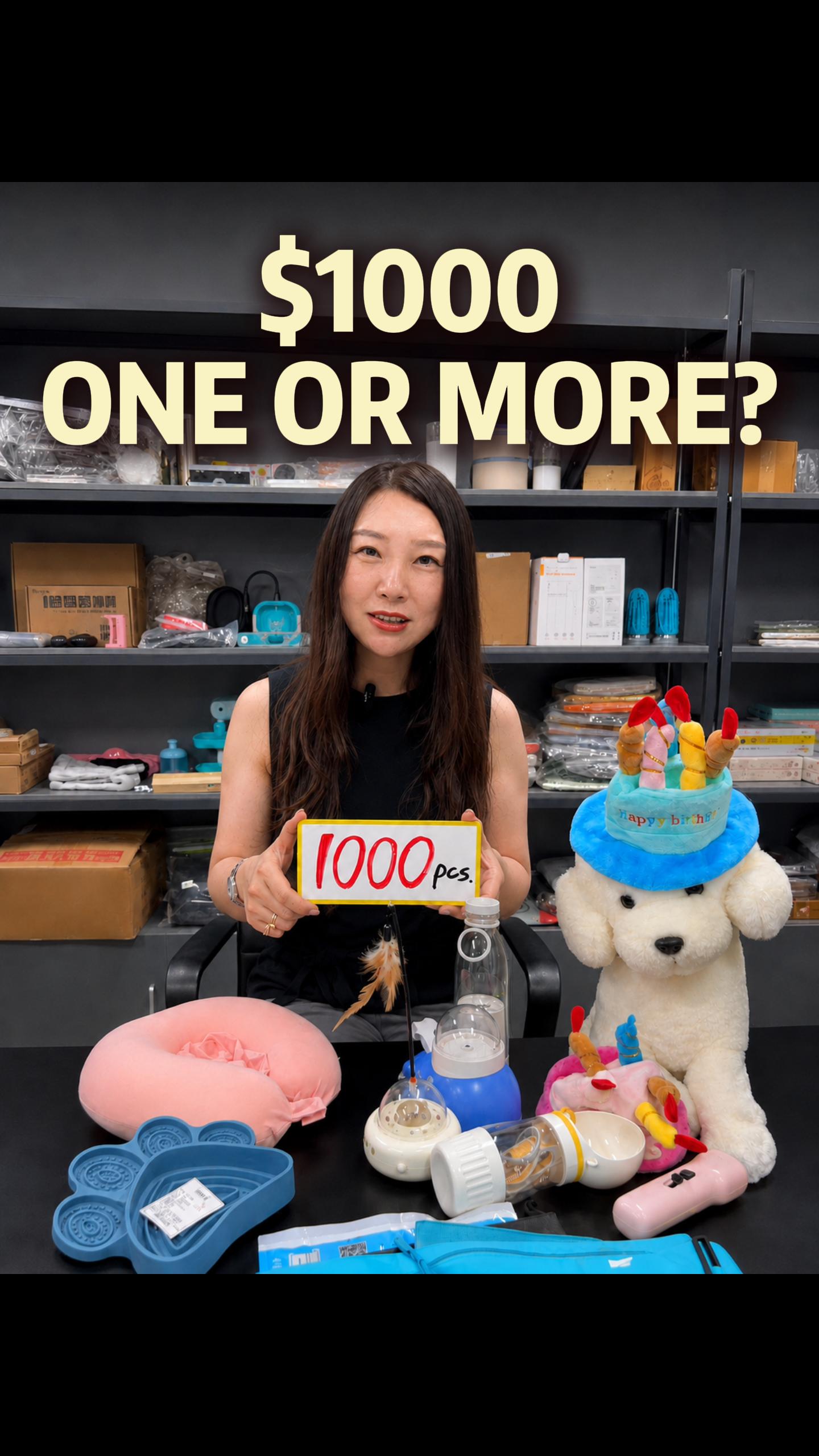
$1,000 for One Product or More? How to Test Multiple Products From China
You have a $1,000 sourcing budget.
Would you rather spend it all on one product?
Or use the same budget to test several products first?
For a buyer who already knows exactly what customers want, buying a larger quantity of one proven product may make sense.
But for a new seller, a new category, or an untested market, putting the entire budget into one SKU creates a different kind of risk:
What if you chose the wrong product?
When supplier conditions allow, another strategy is to divide the budget across several products, test smaller quantities, collect real sales data, and then place a larger reorder for the products that perform best.
The principle is simple:
Test small → Learn → Reorder the winners
This does not work for every product or every supplier.
MOQ, unit price, packaging, customization, and freight still matter.
But flexible sourcing can give smaller buyers more ways to use limited purchasing capital.
Is It Better to Buy One Product or Several Products?
Neither strategy is always better.
The right answer depends on how much you already know about the market.
If you already have reliable sales history for one product, concentrating inventory may be efficient.
If you are still testing demand, diversification can provide more information.
Consider two buyers.
Buyer A
Has sold the same storage product for two years.
They know:
Monthly sales
Best colors
Selling price
Return rate
Reorder timing
Using $1,000 to purchase more of that product may be reasonable.
Buyer B
Is entering the home-storage category for the first time.
They do not yet know:
Which product customers prefer
Which price point works
Which style converts
Which product will receive repeat orders
Putting the entire $1,000 into one SKU creates much more uncertainty.
For Buyer B, testing several products may provide better information.
The Problem With Going All-In Too Early
Imagine spending your entire first purchasing budget on one product.
You order a large quantity.
Then you discover:
Customers prefer another style
The selling price is too high
Shipping costs reduce your margin
The product receives poor reviews
The color is not popular
The packaging does not work
Demand is weaker than expected
Now most of your cash is sitting inside one inventory decision.
This is called concentration risk.
The product itself may not be terrible.
But your business has very few alternatives because too much inventory is tied to one SKU.
What Is Product Testing in Sourcing?
Product testing means purchasing a controlled initial quantity before committing to a much larger order.
For example, instead of immediately ordering:
1,000 PCS of Product A
a buyer may test smaller quantities across several options.
An illustrative test could look like:
Product A: small batch
Product B: small batch
Product C: small batch
Product D: small batch
Product E: small batch
The exact quantities depend on each supplier's MOQ and unit price.
The purpose is not simply to own more SKUs.
It is to collect information.
What Are You Actually Testing?
A test order can help answer questions such as:
Does the Product Sell?
This is the most obvious question.
But it is not the only one.
Which Product Sells Faster?
Product A and Product B may both sell, but one may turn inventory much faster.
Which Price Point Works?
Customers may respond differently to products at different selling prices.
Which Product Has Better Margin?
A cheaper factory price does not always create better profit.
Which Product Gets Better Reviews?
Customer feedback can reveal which products deserve a larger reorder.
Which Product Has Fewer Returns?
A product that sells quickly but generates many returns may not be the real winner.
Which Product Is Easier to Reorder?
Supplier reliability and lead time also matter when scaling.
Why Can Multiple Small Tests Be More Useful Than One Large Order?
Suppose your first sourcing decision gives you only one answer:
Product A works or Product A does not work.
Now compare that with a test involving several products.
You may learn:
Product A: weak
Product B: strong
Product C: good margin but slow sales
Product D: high returns
Product E: strong repeat demand
The same general testing period produces much more market information.
That information can improve the next purchasing decision.
Does This Mean Buyers Should Always Buy 10 Products?
No.
The number “10” is useful as a simple example, not a rule.
Testing too many products also creates problems.
Every additional SKU can require:
Product research
Listing creation
Photography
Packaging
Inventory tracking
Advertising
Customer service
A very small business may be overwhelmed by 20 new products at once.
The better objective is:
Enough variety to learn, but not so much variety that operations become unmanageable.
How Should Buyers Choose Products to Test?
Do not select ten random products simply because they fit the budget.
A stronger test uses products that answer specific questions.
For example, a pet-products seller might compare:
Different Product Types
Pet grooming tool
Pet toy
Travel bottle
Feeding accessory
This tests category demand.
Different Price Points
Entry-level item
Mid-range item
Higher-value item
This tests customer willingness to spend.
Different Designs
Simple
Colorful
Premium-looking
This tests customer preference.
Different Functions
Products solving different problems can reveal which need is strongest.
Each test should teach you something.
Start With One Target Customer
Testing multiple products does not mean targeting multiple unrelated customers.
A better test often keeps the target customer consistent.
For example:
Target customer: US pet owners
Then test several relevant products.
This is stronger than testing:
Pet toy
Kitchen organizer
Baby bib
Car accessory
Office stationery
unless your business is intentionally a broad general retailer.
A focused test makes the results easier to interpret.
Keep the Sales Channel Consistent
Sales channel also matters.
Products suitable for:
Amazon
Independent ecommerce
Retail stores
Wholesale
Social commerce
may require different pricing and packaging.
If you are testing products for one channel, evaluate them under similar conditions.
For example:
US ecommerce → five compact pet accessories
gives more comparable information than mixing products designed for completely different channels.
What Does “Start Small” Actually Mean?
“Small” is relative.
For one product:
50 PCS
may be small.
For another:
500 PCS
may be the factory minimum.
For another ready-stock item:
20 PCS
may be possible.
That is why buyers should never assume that all products can be tested at the same quantity.
The appropriate test order depends on:
Supplier MOQ
Stock availability
Unit price
Carton quantity
Customization
Packaging
Shipping economics
Flexible sourcing means checking what is realistically possible for each product.
Why Does Ready Stock Help With Product Testing?
Ready-stock products can sometimes offer more flexibility because the supplier has already produced the goods.
That may allow buyers to purchase:
Smaller quantities
Mixed colors
Several models
Faster shipments
without starting a new production run.
This makes ready stock useful for certain market tests.
However, stock availability can change quickly.
Buyers should confirm actual inventory before placing the order.
What About Factory MOQ?
Factories usually have minimum quantities because production requires:
Material preparation
Machine setup
Labor
Packaging
Scheduling
For custom production, the MOQ may still be too high for a small test.
In that situation, sourcing teams may explore:
Ready-stock alternatives
Existing colors
Standard packaging
Wholesalers
Different suppliers
Mixed-product options
Not every MOQ can or should be bypassed.
The goal is to find a supply structure that fits the buyer's testing stage.
Should Test Products Be Customized?
Usually, buyers should be cautious about heavy customization during the earliest testing stage.
Full customization may require:
Higher MOQ
Custom packaging
Printing setup
New molds
Longer lead time
Higher upfront cost
If customer demand is still unknown, these costs increase the risk of the test.
Where suitable, early testing may use:
Standard product
Existing color
Simple packaging
Light branding
Small logo customization
After a product proves itself, deeper customization can make more sense.
Test the Product Before Testing the Brand
A useful sequence is:
Stage 1
Does anyone want this product?
Stage 2
Which version do they want?
Stage 3
Can I sell it profitably?
Stage 4
Should I invest in branding and customization?
Many buyers reverse the order.
They spend heavily on:
Custom packaging
Logos
Exclusive colors
Large inventory
before proving basic product demand.
That can make an unsuccessful test unnecessarily expensive.
How Should a $1,000 Budget Be Divided?
There is no universal formula.
For illustration, one buyer might use:
$1,000 → 5 products
Another might use:
$1,000 → 10 small ready-stock products
Another might decide:
$700 inventory + $300 samples, packaging, and logistics
The correct allocation depends on:
Unit prices
MOQ
Freight
Sales channel
Testing objective
The number of products should follow the strategy—not the headline.
Don't Spend the Entire Budget on Product Cost
This is important.
If your total available budget is $1,000, do not automatically allocate the full $1,000 to factory prices.
Other costs may include:
Domestic China delivery
Packaging
Labels
Quality inspection
Consolidation
International freight
Duties
Fulfillment
A test budget should consider landed cost.
Otherwise, the products may fit the purchasing budget but not the complete business budget.
How Does Consolidation Help?
If you test products from several suppliers, separate international shipments can become inefficient.
For example:
Supplier A → international shipment
Supplier B → international shipment
Supplier C → international shipment
Instead, the products may first be delivered to one warehouse in China.
The process becomes:
Supplier A + Supplier B + Supplier C
↓
One consolidation warehouse
↓
Receive and organize
↓
Combined shipment
This can simplify multi-supplier testing.
Whether consolidation reduces freight depends on the actual shipment, so costs should be calculated rather than assumed.
What Should Be Checked When Products Arrive at the Warehouse?
For mixed-product sourcing, organization becomes important.
Depending on the agreed service scope, checks may include:
Supplier
Product
SKU
Quantity
Color
Model
Packaging
Labels
If finished-product inspection is required, additional agreed checks can include:
Appearance and workmanship
Dimensions
Basic functions
Packaging
Final pre-shipment confirmation
The buyer needs to know which physical goods belong to which test.
How Do You Know Which Product Won?
Sales volume alone is not enough.
A useful test should track several metrics.
Sales Speed
How quickly does inventory move?
Gross Margin
How much margin remains after relevant costs?
Conversion
How effectively does customer traffic turn into purchases?
Returns
Are buyers satisfied after receiving the product?
Reviews
What do customers like or dislike?
Advertising Cost
Does the product require expensive acquisition?
Reorder Potential
Will customers or retailers buy it again?
A product that sells the most units may not create the best business result.
Example Test Results
Imagine testing five products.
| Product | Sales | Margin | Returns | Decision |
|---|---|---|---|---|
| A | High | Good | Low | Scale |
| B | Medium | Excellent | Low | Scale |
| C | High | Poor | High | Review |
| D | Low | Good | Low | Stop |
| E | Medium | Good | Low | Test again |
This produces a much better next order than simply saying:
“Product A sold the most.”
What Does “Test 50, Reorder 1,000” Mean?
The principle is:
Small initial commitment → larger commitment after evidence
It does not mean every business should literally order 50 first and exactly 1,000 later.
The actual numbers depend on:
Product
Supplier MOQ
Selling speed
Cash flow
Reorder lead time
Inventory capacity
The important part is the sequence.
Do not scale because you hope it will sell.
Scale because the test gives you a reason to.
When Should You Reorder?
A winner should be reordered before the test inventory reaches zero.
Consider:
Daily sales
Remaining stock
Production lead time
International shipping
Customs
Warehouse receiving
For example, if the complete replenishment cycle takes 45 days, waiting until only five units remain may be too late.
A good test should also teach you the correct reorder point.
What If Several Products Win?
That is a good problem.
You do not necessarily need to choose only one.
If Product A, B, and C all perform well, the next purchasing budget can be allocated according to actual results.
For example:
50% → Product A
30% → Product B
20% → Product C
The exact ratio should reflect:
Sales
Margin
inventory turnover
Supplier lead time
Business strategy
Now the purchasing decision is based on evidence rather than guesses.
What If None of the Products Sell?
That is also useful information.
A controlled test limits the cost of learning.
Imagine the alternative:
You put the entire budget into one SKU and discover the same problem.
Testing is not only designed to find winners.
It is also designed to identify weak products before the order becomes much larger.
Is a Failed Test a Waste of Money?
Not necessarily.
If the test helps you learn:
Wrong product
Wrong price
Wrong customer
Wrong packaging
Wrong sales channel
that information can improve the next decision.
The real danger is not a small test that fails.
It is scaling an untested assumption.
When Is a Large First Order Reasonable?
There are situations where a larger initial purchase makes sense.
For example:
Existing product with proven sales
Confirmed wholesale order
Established retailer demand
Strong historical sales data
Customer preorder
Reliable repeat product
In these cases, the buyer is not testing the product from zero.
They already have evidence.
The sourcing strategy should therefore match the buyer's stage.
New Product vs. Repeat Product
Think of purchasing in two modes.
Discovery Mode
Goal:
Learn what works.
Strategy:
More variety
Smaller quantities
Lower inventory commitment
Faster learning
Scaling Mode
Goal:
Improve efficiency.
Strategy:
Fewer proven products
Larger quantities
Better pricing
Customization
More efficient packaging
The same buyer may use both modes at the same time for different products.
Why Flexible Sourcing Matters
Traditional factory sourcing often assumes:
Choose one product → Meet factory MOQ → Place production order
That works well when demand is already known.
But newer businesses may need:
Several products → Smaller quantities → Test → Reorder winners
This requires more coordination because buyers may use:
Different suppliers
Ready stock
Mixed colors
Multiple SKUs
Consolidation
A sourcing company can help coordinate these moving parts.
Does More Products Mean More Risk?
It can.
Diversifying inventory reduces concentration risk, but it increases operational complexity.
More SKUs mean more:
Supplier communication
Product information
Labels
Inventory records
Listings
Packaging
Order management
That is why “more products” is not automatically better.
The objective is controlled diversification.
Avoid the “One of Everything” Problem
When buyers enter Yiwu or browse supplier catalogs, the enormous product selection can become tempting.
They begin buying:
“One of this.”
“Some of that.”
“And maybe this too.”
Soon the test has no clear strategy.
A better test begins with a hypothesis.
For example:
Which compact kitchen-organization products work best for US ecommerce customers under a $25 retail price?
Now every test SKU serves the same business question.
Use Product Families
One efficient approach is testing within one product family.
For example:
Storage
Drawer organizer
Fridge organizer
Foldable basket
Under-sink organizer
Pet Products
Grooming tool
Travel bottle
Feeding accessory
Toy
Kitchen
Utensil
Storage container
Cleaning tool
Organizer
This keeps the customer and sales channel relatively consistent while still testing different needs.
How Can Buyers Compare Suppliers During a Test?
A test order can also evaluate the supplier.
Track:
Communication
Product accuracy
Delivery timing
Packaging
Quantity accuracy
Quality consistency
A strong-selling product from an unreliable supplier creates another problem.
Before scaling from a small test to a large reorder, confirm that the supplier can support the larger volume.
Do Not Assume the Test Supplier Can Scale
Suppose you test 50 units successfully.
Now you want 1,000.
Ask again:
Can the supplier handle 1,000?
Does the price change?
Does the lead time change?
Will the product specification stay the same?
Does packaging change?
Is stock still available?
Is production required?
Small-order capability and bulk-order capability are different questions.
Test ready ≠ scale ready.
How Can a Sourcing Company Help?
A sourcing company can help structure a multi-product test while keeping the supply chain manageable.
Depending on the project, support may include:
Finding several relevant product options
Comparing suppliers
Checking ready stock
Confirming MOQ
Checking mixed-color options
Collecting samples
Coordinating multiple suppliers
Receiving products in one warehouse
Finished-product quality inspection
Order consolidation
Packaging coordination
Worldwide shipping
The goal is not to convince buyers to purchase more products.
The goal is to make testing possible when diversification fits the buyer's business stage.
What Information Should Buyers Send?
Instead of saying:
“I have $1,000. Find anything I can buy.”
send a clear sourcing brief.
For example:
Budget: Approximately $1,000 for initial products
Category: Pet accessories
Market: United States
Channel: Ecommerce
Goal: Test 5–10 products
Priority: Ready stock / small MOQ
Target retail price: $15–$30
Customization: Not required for first test
This gives the sourcing team a real direction.
A Better $1,000 Test Strategy
A practical workflow can look like this:
Step 1 — Define one target customer
↓
Step 2 — Define one product category
↓
Step 3 — Find several relevant products
↓
Step 4 — Check MOQ and stock
↓
Step 5 — Calculate product + logistics costs
↓
Step 6 — Select manageable test quantities
↓
Step 7 — Consolidate when practical
↓
Step 8 — Launch the products
↓
Step 9 — Measure sales, margin, and returns
↓
Step 10 — Reorder the winners at larger quantities
This turns a limited budget into a learning process.
One Product or More?
The answer depends on how much evidence you already have.
Choose a Larger Quantity of One Product When:
Demand is proven
You have reliable sales data
Reorders are predictable
The supplier is stable
You want better scale efficiency
Test Several Products When:
The category is new
Customer demand is uncertain
You are entering a new market
You want to compare product types
Small quantities are available
You need real sales data before scaling
The sourcing strategy should match the amount of uncertainty.
Conclusion
If you have $1,000, the most important question is not simply:
“How many products can I buy?”
It is:
“How can I use this budget to make a better next purchasing decision?”
For an untested category, putting the entire budget into one product may create unnecessary inventory risk.
When supplier conditions allow, testing several products in smaller quantities can help buyers discover:
What customers actually want
Which price works
Which products create better margins
Which suppliers perform reliably
Which SKU deserves the larger reorder
Then the next purchase can become more focused.
Test small.
Keep the data.
Scale what works.
About Youshow
Youshow is a Yiwu-based sourcing company helping global buyers source and manage products from China.
Our services include:
Small-quantity product sourcing
Mixed-product sourcing
Ready-stock sourcing
Supplier comparison and evaluation
MOQ and stock confirmation
Sample collection
Finished-product quality inspection
OEM and ODM customization
Packaging coordination
Multi-supplier order consolidation
Export certification support
Worldwide shipping coordination
We help importers, wholesalers, retailers, Amazon sellers, and ecommerce businesses simplify procurement and reduce sourcing risks.
For buyers testing a new category, our team can help compare multiple product options, supplier MOQs, ready-stock availability, packaging, and consolidation possibilities so the initial sourcing plan does not necessarily depend on placing a large order for one untested SKU.
The exact number of products and test quantities depends on the product, supplier, budget, and shipping economics.
The objective is not simply to buy more SKUs.
It is to learn before you scale.

