
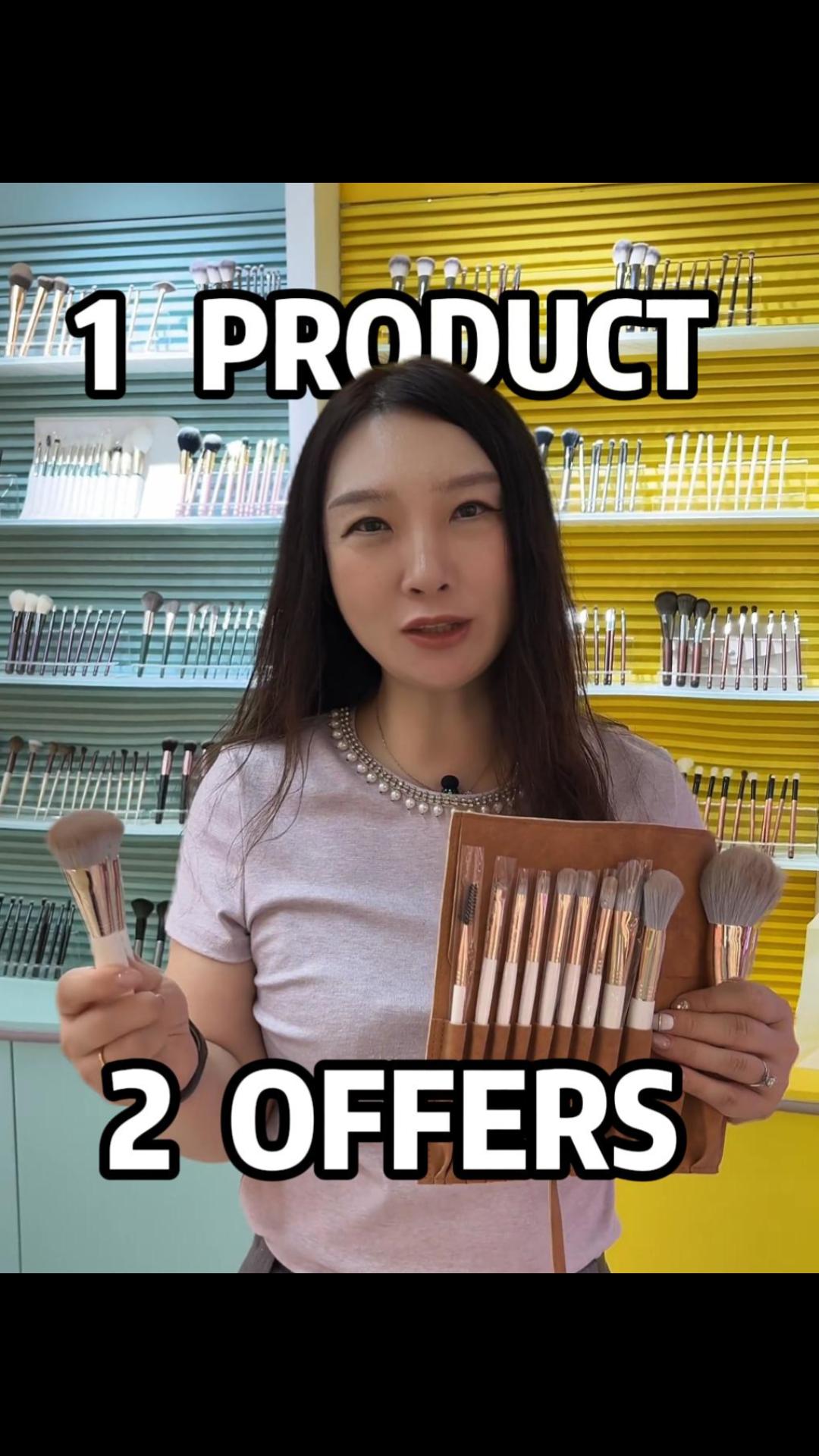
Single Product or Bundle? How to Create Two Offers From One Product Line
One product does not always need one selling format.
Imagine sourcing a set of makeup brushes from China.
You could sell the complete brush set as one product.
But you could also separate selected brushes and sell them individually.
Now the same product line creates two different offers:
One brush — a lower-entry option
and
The full set — a higher-value option
The products themselves have not fundamentally changed.
What changed is how they are packaged, priced, and presented to customers.
For buyers sourcing products from China, thinking about the final offer before placing the order can help create more flexible pricing, product bundles, and customer choices.
Should You Sell Products Individually or as a Set?
There is no universal answer.
The right option depends on:
Your target customer
Sales channel
Product category
Selling price
Customer buying behavior
Packaging
Fulfillment costs
Inventory strategy
In many cases, buyers do not have to choose only one.
The same product family can support both:
Individual products + complete bundles
This creates multiple entry points for customers.
What Is a Product Offer?
A product and an offer are not exactly the same thing.
The product is what you physically source.
The offer is how you package and sell it.
For example, you may source:
10 different makeup brushes
From those products, you could create:
Offer A
One individual brush
Offer B
Five-brush starter set
Offer C
Ten-brush complete set
The sourcing category is the same.
But the customer sees three different purchasing options.
That distinction can be useful when planning products before ordering from suppliers.
Why Sell a Single Item?
A single product usually creates a lower purchase barrier.
A customer who is not ready to buy a complete set may be willing to try one item first.
For example:
Instead of asking a customer to purchase an entire makeup brush collection, the seller can offer one commonly used brush individually.
This may be useful for:
First-time customers
Price-sensitive customers
Product testing
Replacement purchases
Customers who only need one function
Entry-level offers
The customer can experience the product without committing to the full set.
Why Sell the Full Set?
A complete set creates a different value proposition.
Instead of selling one tool for one function, the seller offers a complete solution.
For makeup brushes, each brush may have a specific role:
Foundation
Powder
Blush
Eyeshadow
Blending
Contouring
Individually, each brush solves one small need.
Together, they create a complete makeup routine.
That makes the set easier to position as a higher-value offer.
Individual Product vs. Bundle
The basic difference can look like this:
| Factor | Individual Product | Full Set |
|---|---|---|
| Customer commitment | Lower | Higher |
| Selling price | Lower | Higher |
| Number of functions | One or limited | Multiple |
| Entry barrier | Lower | Higher |
| Packaging | Simpler | More important |
| Gift potential | Lower | Often higher |
| Upsell opportunity | Can lead to set | Already bundled |
| Customer type | Trial / replacement | Full-solution buyer |
Neither format is automatically better.
They serve different customers.
Why Does This Matter Before Sourcing?
Buyers sometimes wait until products arrive before deciding how to sell them.
That can create problems.
If you know in advance that you want both individual products and full sets, you may need different:
Packaging
Labels
Barcodes
SKU numbers
Quantities
Product combinations
Carton planning
For example, if 1,000 brushes arrive already packed permanently into 100 ten-piece sets, converting part of that stock into individual products may require reopening and repacking everything.
Planning the offer earlier can make the sourcing process more efficient.
Start With the Customer Need
The easiest way to create bundles is not simply grouping random products together.
Ask:
What is the customer trying to accomplish?
In the makeup-brush example, each brush has a specific job.
The complete set becomes valuable because the brushes work together within the same routine.
This principle can apply to many categories.
Kitchen Products
Individual offer:
One kitchen tool
Bundle:
Complete cooking-tool set
Storage Products
Individual offer:
One storage container
Bundle:
Multi-size organization set
Pet Products
Individual offer:
One grooming accessory
Bundle:
Pet grooming kit
Travel Products
Individual offer:
One travel bottle
Bundle:
Complete travel-container set
Baby Products
Individual offer:
One feeding item
Bundle:
Feeding starter set
A useful bundle should make sense together.
Do Not Bundle Products Just to Increase the Price
A larger bundle is not automatically more valuable.
If customers do not understand why the products belong together, the bundle may feel unnecessary.
A better question is:
Do these products solve related needs?
Strong bundles often have one clear theme:
Starter kit
Complete routine
Travel set
Gift set
Professional set
Refill pack
Essentials set
The customer should immediately understand why the items are sold together.
What Is an Entry-Level Offer?
An entry-level offer gives customers a lower-cost way to start.
It may be:
One product
A smaller size
A basic version
A smaller bundle
A trial pack
Its purpose is not necessarily to generate the highest order value.
It may help customers become comfortable with the product or brand.
For example:
One brush = easy entry
Once customers understand the quality and function, they may later consider:
Full brush set = higher-value purchase
What Is a Higher-Value Offer?
A higher-value offer usually provides:
More products
More functions
Better packaging
Greater convenience
A more complete solution
The important word is value, not simply price.
If the customer pays more, the offer should make it clear what additional benefit they receive.
For example:
Instead of:
“10 brushes cost more than one brush.”
the positioning becomes:
“One complete set covers your full makeup routine.”
That is easier for customers to understand.
Can Bundles Increase Average Order Value?
Potentially.
If customers see value in purchasing several related products together, a bundle can increase the amount purchased in one transaction.
However, this depends on:
Product-market fit
Bundle composition
Price difference
Customer demand
Sales channel
Buyers should not assume that simply creating a bundle will automatically increase sales.
The offer still needs to fit the customer.
How Should You Price a Bundle?
A bundle does not always need to equal the sum of every individual selling price.
For example:
If one brush sells for $8 and a set contains 10 brushes, the seller does not necessarily need to price the set at $80.
The bundle may use a different pricing strategy.
The buyer should calculate:
Product cost
Packaging cost
Fulfillment cost
Shipping
Marketplace fees
Desired margin
Customer-perceived value
Then decide how much incentive customers should receive for purchasing the larger offer.
Should the Bundle Be Cheaper Per Item?
Often, customers expect a set to provide better value than purchasing every component separately.
For example:
Individual brush: $8
Ten individual brushes:
$80
Complete set:
$59
The bundle now gives the customer a reason to choose the larger purchase.
But the exact pricing structure depends on the business.
The seller must still protect the required margin.
Why Packaging Matters More for Bundles
Individual products can sometimes use relatively simple packaging.
A full set usually requires more organization.
Buyers may need to consider:
Product positioning
Inner trays
Pouches
Boxes
Inserts
Product names
Instructions
Branding
Barcodes
For a bundle, packaging also helps explain that customers are receiving a complete solution rather than several unrelated items.
This can increase perceived value.
Should Individual Items and Bundles Have Different SKUs?
Usually, they should be managed as separate selling units.
For example:
Brush A = SKU 001
Brush B = SKU 002
Full brush set = SKU 010
This helps with:
Inventory management
Retail systems
Ecommerce listings
Warehouse picking
Replenishment
Sales analysis
The exact SKU structure depends on the seller's system.
But individual products and bundles should be clearly distinguishable.
How Should Buyers Plan Quantities?
This becomes important when the same products are used in multiple offers.
Suppose you purchase:
1,000 units of Brush A.
You plan to use:
400 as individual products
600 inside complete sets
Then the quantity of every other brush required for the sets must also be calculated.
A simple planning table can help:
| Product | Individual Sales | Used in Sets | Total Needed |
|---|---|---|---|
| Brush A | 400 | 600 | 1,000 |
| Brush B | 200 | 600 | 800 |
| Brush C | 100 | 600 | 700 |
Without this planning, one component can run out and prevent complete sets from being assembled.
What Is the Biggest Risk With Bundles?
One missing component can make the entire bundle incomplete.
Imagine a ten-piece set.
The warehouse has plenty of nine brushes but runs out of Brush No. 10.
Even though thousands of individual pieces remain in stock, complete sets cannot be prepared.
This is why bundle inventory needs to be planned around the component with the lowest available quantity.
Can a Sourcing Company Assemble Bundles in China?
Depending on the project, products can sometimes be sourced separately and assembled into the final set before shipment.
For example:
Supplier A provides Product A.
Supplier B provides Product B.
Supplier C provides the packaging.
The goods can be delivered to a consolidation location and organized according to the buyer's final bundle requirements.
This may be useful when no single supplier offers the exact combination the buyer wants.
However, the process requires clear:
Product specifications
Quantities
Packaging
Labels
Assembly instructions
Quality requirements
Do All Products in a Bundle Need to Come From One Supplier?
No.
Sometimes one supplier specializes in the main product while another provides better accessories.
A sourcing team may compare several suppliers and combine suitable products into one offer.
For example:
Main product from Supplier A
Accessory from Supplier B
Packaging from Supplier C
=
Final retail set
This provides more flexibility than forcing one factory to supply everything.
But it also creates more coordination work.
When Is One Supplier Better?
Using one supplier may be easier when:
The supplier already offers the complete set
Quality is acceptable
Pricing works
Packaging is suitable
MOQ is manageable
Supply is reliable
The objective is not to use more suppliers unnecessarily.
The objective is to create the right offer using the most practical supply structure.
How Can Small Buyers Test Two Offers?
Small businesses do not always need to commit to one format immediately.
Where supplier MOQ and packaging conditions allow, a buyer may test:
Offer A
Individual product
Offer B
Complete set
Then compare:
Conversion
Customer feedback
Margin
Repeat purchases
Return rate
Inventory speed
This produces real sales information.
The next sourcing order can be adjusted based on which offer performs better.
What If Customers Prefer Only One Item?
That is useful information.
Suppose buyers repeatedly purchase one brush individually but rarely purchase the full set.
The seller may decide to:
Increase stock of that brush
Reduce full-set inventory
Build a smaller bundle around popular items
Create a replacement pack
Change the bundle price
Flexible sourcing allows the product offer to evolve with customer demand.
What If Customers Prefer the Full Set?
Then the next order may focus more heavily on complete bundles.
The buyer may also explore:
Better set packaging
Custom branding
Gift packaging
Exclusive colors
Larger quantities
Factory-level customization
The first test helps determine where deeper investment makes sense.
Can You Create More Than Two Offers?
Yes.
One product family can sometimes support several levels.
For example:
Entry Offer
1 brush
Starter Offer
3 brushes
Core Offer
6 brushes
Complete Offer
10 brushes
However, too many choices can also confuse customers.
The number of offers should match the sales channel and customer behavior.
The objective is not to create as many bundles as possible.
It is to create meaningful choices.
How Does Sales Channel Affect Bundling?
Ecommerce
Bundles can help sellers:
Create differentiated listings
Increase perceived value
Combine related products
Build giftable offers
But fulfillment costs and packaging dimensions should be checked.
Physical Retail
Retail bundles need:
Clear packaging
Shelf-friendly dimensions
Easy product understanding
Appropriate price points
Wholesale
Wholesalers may prefer:
Several assortment options
Case packs
Flexible color combinations
Stable repeat supply
Different channels may therefore require different combinations of the same underlying products.
Product Sourcing Should Consider the Offer
A buyer may initially send a sourcing agent a photo and say:
“I need this product.”
But more useful information is:
“I want to sell this product individually and also create a complete set.”
That changes the sourcing questions.
The sourcing team may now need to check:
Individual product MOQ
Set MOQ
Packaging
Component quantities
Separate prices
Bundle assembly
Labels
Carton planning
Knowing the sales plan earlier can improve the purchasing plan.
What Information Should Buyers Send?
If you want to create several offers from one product line, send:
Product References
Which products should be included?
Individual Offer
Which items need to be sold separately?
Bundle Structure
What should be included in each set?
Quantity
How many individual units and how many sets?
Packaging
Individual packaging or custom set packaging?
Target Market
Where will the products be sold?
Sales Channel
Ecommerce, retail, wholesale, or another channel?
Target Price
What selling-price range are you trying to create?
This helps the sourcing team understand the business goal behind the order.
How Can a Sourcing Company Help?
A sourcing company can help buyers evaluate the supply side of an individual-product and bundle strategy.
Depending on the project, this may include:
Sourcing individual products
Comparing suppliers
Checking MOQ
Calculating component quantities
Collecting samples
Comparing individual and set packaging
Coordinating custom packaging
Organizing bundle assembly
Finished-product quality inspection
Checking labels and quantities
Consolidating products from different suppliers
Coordinating worldwide shipping
The sourcing company's role is not to guarantee which offer will sell better.
The goal is to help build a purchasing structure that supports the buyer's intended sales strategy.
A Simple Two-Offer Sourcing Strategy
A practical process can look like this:
Step 1 — Identify the core product
↓
Step 2 — Define the entry-level offer
↓
Step 3 — Define the higher-value bundle
↓
Step 4 — Calculate component quantities
↓
Step 5 — Confirm supplier MOQ
↓
Step 6 — Plan individual and bundle packaging
↓
Step 7 — Test both offers
↓
Step 8 — Use sales data to adjust the next order
This connects product sourcing with actual customer behavior.
Conclusion
One product line does not always need one offer.
The same products can sometimes support:
A lower-entry individual option
and
A higher-value complete set
This gives customers different ways to buy while allowing sellers to test different price points and purchasing behaviors.
The key is to think about the offer before the products are ordered.
Ask:
Which items should be sold individually?
Which products work better together?
What quantity is needed for each?
How will they be packaged?
What value does the bundle create?
Which option fits each customer?
Good sourcing is not only about finding products.
It is also about making sure the supply plan supports the way those products will actually be sold.
About Youshow
Youshow is a Yiwu-based sourcing company helping global buyers source and manage products from China.
Our services include:
Product sourcing
Supplier comparison and evaluation
Multi-product sourcing
Small-quantity and mixed-product sourcing
Sample collection
Product-set and packaging coordination
Finished-product quality inspection
OEM and ODM customization
Order consolidation
Export certification support
Worldwide shipping coordination
We help importers, wholesalers, retailers, Amazon sellers, and ecommerce businesses simplify procurement and reduce sourcing risks.
When buyers want to create individual products and bundled offers from the same product line, our team can help compare suppliers, MOQ, component quantities, packaging options, and consolidation requirements so the sourcing plan supports the intended sales strategy.

