
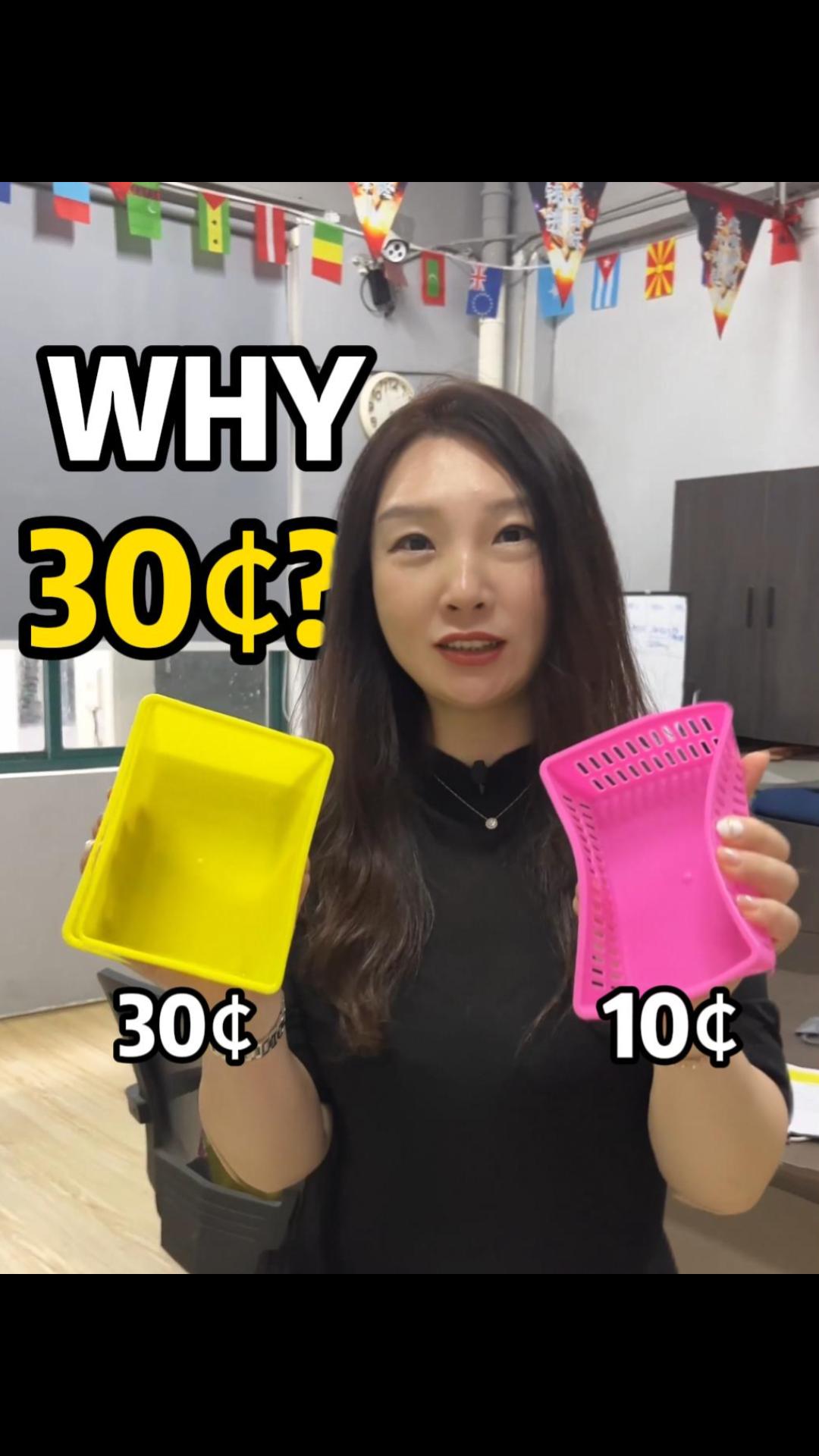
10¢ or 30¢? How to Choose the Right Product Quality Level From China
Two products look almost the same.
One costs 10 cents.
The other costs 30 cents.
Which one should you buy?
The obvious answer may seem to be:
“Choose the cheaper one.”
But that is not always the right sourcing decision.
In our example, the 10-cent product bends much more easily.
The 30-cent version stays firmer and holds its shape better.
Does that mean the 10-cent product is bad?
Not necessarily.
If the product will only be used for a short promotional campaign, the lower-cost version may be completely suitable.
If customers are expected to use the product repeatedly, the more durable version may make more sense.
The real sourcing question is not:
“Which product is cheaper?”
It is:
“Which level of quality does my customer actually need?”
Why Can Two Similar Products Have Very Different Prices?
When sourcing products from China, visually similar products can have different costs because of differences in:
Material
Material thickness
Product weight
Structural strength
Manufacturing process
Components
Surface finishing
Packaging
Quality consistency
From a product photo, these differences may be difficult to see.
But once you hold and use the products, the difference can become obvious.
That is why price comparison should always include product specifications and intended use.
Is the Cheapest Product Always the Worst?
No.
This is an important distinction.
A lower-priced product may simply be designed for a different application.
For example, a lightweight plastic basket may be perfectly suitable for:
Short-term promotions
Event giveaways
Temporary displays
Low-cost gift sets
Limited-use campaigns
In those situations, paying three times more for extra durability may provide little additional business value.
The lower-priced product may actually be the more appropriate purchasing decision.
Is the More Expensive Product Always Better?
No.
A more expensive product may offer:
Greater strength
Thicker material
Better durability
Better finishing
More stable construction
But buyers should still ask:
Do my customers need these improvements?
If customers use the product only once, higher durability may not justify the additional purchasing cost.
Professional sourcing is not about buying the highest quality available.
It is about buying the right quality for the intended application.
Start With the Use Case
Before comparing supplier quotations, define how the product will actually be used.
Ask:
Who is the customer?
How often will they use it?
How long should it last?
What will they put inside it?
Is it a giveaway or retail product?
Is it part of a premium brand?
Will customers expect repeated use?
What selling price is planned?
These questions determine which quality differences actually matter.
Example: Short-Term Promotion
Imagine a company needs 10,000 small plastic baskets for a one-week promotional event.
The baskets will:
Hold lightweight samples
Be used temporarily
Be given away
Not be positioned as a premium retail product
In this case, a lighter 10-cent version may be sufficient if it can safely perform the required function.
The buyer may not benefit from paying significantly more for long-term durability.
The purchasing objective is:
Suitable performance at the required cost.
Example: Repeat Retail Use
Now imagine the same type of basket is sold as a household organizer.
Customers may expect to:
Use it every day
Carry products inside
Store household items
Reuse it for months or years
Now durability becomes more important.
A product that bends easily may lead to:
Poor customer experience
Negative reviews
Returns
Complaints
Lower repeat purchases
In this case, the stronger 30-cent version may provide better value.
The product looks similar.
The use case changes the correct sourcing decision.
Promotion vs. Repeat Use
A simple comparison looks like this:
| Factor | Short-Term Promotion | Repeat Use |
|---|---|---|
| Expected lifespan | Short | Longer |
| Durability requirement | Lower | Higher |
| Price sensitivity | Often high | Balanced |
| Product strength | Basic may be enough | More important |
| Customer expectation | Limited | Higher |
| Repeat handling | Low | High |
| Best option | Lower-cost version may work | More durable version may be better |
This is why buyers should communicate the use case before asking a sourcing agent to choose between product options.
What Does the Extra 20 Cents Actually Buy?
Whenever one product costs more than another, buyers should ask:
What am I getting for the additional cost?
The answer could be:
Thicker plastic
More material
Stronger structure
Better components
Better finishing
Improved packaging
More consistent production
If the supplier cannot explain the difference, compare actual samples.
The goal is to understand whether the price gap corresponds to a meaningful product difference.
Compare the Products Physically
Photos are often not enough.
Two products may look nearly identical online.
But physical comparison can reveal differences in:
Flexibility
Weight
Thickness
Stability
Surface feel
Fit
Construction
Basic function
In the example shown in this video, bending the products immediately reveals the difference.
The cheaper version flexes easily.
The more expensive version remains firmer.
That is useful purchasing information.
Ask Suppliers for Specifications
When comparing different quality levels, request measurable information where possible.
Depending on the product, this may include:
Material type
Product weight
Dimensions
Material thickness
Capacity
Component specifications
Packaging
Units per carton
For example:
Instead of:
Supplier A: $0.10
Supplier B: $0.30
create a comparison such as:
| Factor | Product A | Product B |
|---|---|---|
| Price | $0.10 | $0.30 |
| Material | Confirm | Confirm |
| Weight | Confirm | Confirm |
| Thickness | Confirm | Confirm |
| Flexibility | Higher | Lower |
| Intended use | Short-term | Repeat use |
| Packaging | Confirm | Confirm |
Now the buyer understands what is behind the price difference.
Why Is Product Weight Useful?
For simple plastic, metal, textile, or similar products, product weight can sometimes provide useful comparison information.
A heavier version may contain more material.
However, weight alone does not prove higher quality.
Differences can also come from:
Material density
Product structure
Design
Components
Weight should therefore be used together with:
Material information
Physical samples
Dimensions
Functional evaluation
Never judge product quality from one specification alone.
What About Material Thickness?
Thickness can be important for products such as:
Plastic storage items
Bags
Metal products
Containers
Packaging
Household items
A small difference in material thickness may significantly affect:
Rigidity
Durability
Product feel
Weight
Cost
If strength matters to the final customer, thickness may be worth confirming before the order is placed.
Quality Should Match the Selling Price
A sourcing decision should also fit the final retail position.
Imagine two business models.
Discount Promotion
Selling price:
Very low
Customer expectation:
Basic functionality
A premium product specification may make the offer unprofitable.
Branded Retail Product
Selling price:
Higher
Customer expectation:
Better durability and presentation
A very low-cost specification may damage customer perception.
The sourcing specification needs to support the selling strategy.
What About Wholesale Buyers?
Wholesalers should consider their downstream customers.
Ask:
Who will ultimately sell this?
What price point are they targeting?
What level of quality do their customers expect?
Is the product for discount stores or premium retailers?
Is it promotional merchandise?
A wholesaler may even need several quality levels of the same product category.
For example:
Economy version
for promotional customers
and
Standard version
for regular retailers.
Different price points can serve different buyers.
What About Ecommerce Sellers?
For ecommerce, product durability can have additional consequences.
Customers may leave reviews about:
Weak material
Product bending
Breakage
Poor feel
Product not matching expectations
These reviews can influence future sales.
An extra few cents in sourcing cost may make sense if it materially improves the customer experience.
But again, buyers should calculate the full economics rather than automatically choosing the more expensive version.
What About Promotional Products?
Promotional products are a good example of why “cheaper” does not automatically mean “wrong.”
A buyer may need:
20,000 units
One-time event use
Logo printing
Strict total budget
If the lower-cost product safely performs its intended role, choosing it may be commercially sensible.
The important point is transparency.
The buyer should know:
This is the lighter version, designed for limited use.
Then they can make the decision intentionally.
Why Should Buyers Avoid Asking Only for “Best Quality”?
“Best quality” is too vague.
Different buyers mean different things by it.
One buyer means:
Most durable version available.
Another means:
Good enough for retail without becoming too expensive.
Another means:
The cheapest version that can survive one promotion.
Instead of asking:
“Give me the best quality.”
describe the actual requirement.
For example:
“Customers will reuse this product regularly, so it needs to stay firm and hold its shape.”
That gives suppliers and sourcing teams a useful standard.
Why Should Buyers Avoid Asking Only for “Cheapest Price”?
The same problem applies in the other direction.
If you tell five suppliers:
“Give me your cheapest version.”
they may reduce:
Material thickness
Product weight
Components
Finishing
Packaging
Eventually you may receive the requested price—but no longer have the product you originally wanted.
A target price should be connected to a target specification.
Use a Good-Better-Best Comparison
For some categories, it can be useful to ask suppliers for several quality levels.
For example:
Economy
Lowest practical specification for the intended use.
Standard
Balanced price and durability.
Premium
Better materials, construction, or finishing.
Then compare:
Price
Specification
Use case
Target customer
This provides more information than simply asking every supplier for the lowest quotation.
Can a Sourcing Agent Help Compare Quality Levels?
Yes.
A sourcing agent can collect several product options and explain the differences.
For example:
Option A — $0.10
Lighter
More flexible
Suitable for limited-use applications
Option B — $0.30
Firmer
More stable
Better suited to repeated use
The sourcing agent should not automatically tell the buyer:
“Buy Option B because it is better.”
Instead, the buyer should understand:
Why it costs more and whether that difference matters for the intended market.
What Information Should Buyers Send?
When asking a sourcing company to find a product, include the intended use.
Instead of:
“I need this basket. Find the cheapest price.”
send:
Product: Small plastic basket
Quantity: 5,000 PCS
Use: Promotional giveaway
Expected use: Short-term
Target market: United States
Customization: One-color logo
Now the sourcing team knows that premium long-term durability may not be the main priority.
For another project:
Product: Small plastic basket
Quantity: 1,000 PCS
Use: Retail household storage
Expected use: Repeated
Target market: Japan
Priority: Stable structure and clean appearance
This may lead to a completely different product recommendation.
How Should Buyers Test Samples?
When samples arrive, do not only look at them.
Interact with them.
Depending on the product:
Bend it
Open and close it
Assemble it
Carry something in it
Stack it
Compare weight
Compare dimensions
Inspect the surface
Check basic functions
Simple practical comparisons often reveal differences that quotation sheets cannot show.
The test should reflect real customer use.
Does Higher Quality Always Reduce Returns?
Not automatically.
Returns can happen for many reasons:
Product expectations
Wrong sizing
Poor listing information
Damage during shipping
Customer preference
Product defects
However, if the lower-cost version is clearly below the durability expected by the target customer, selecting a more suitable specification may reduce avoidable quality-related complaints.
Again, the key is matching the product to customer expectations.
What About Packaging?
Product quality and packaging quality should be evaluated separately.
A stronger product can still arrive damaged in weak packaging.
Likewise, an inexpensive promotional product may not need premium retail packaging.
Buyers should decide separately:
What product quality do I need?
and
What packaging quality do I need?
Both should fit the sales channel.
What About Shipping Cost?
A stronger product may also be:
Heavier
Larger
Packed differently
That can affect logistics cost.
So when comparing 10 cents vs. 30 cents, calculate more than the factory price.
Consider:
Product price
Product weight
Packaging
Carton dimensions
International freight
Expected selling price
The best option is the one that makes sense across the complete sourcing model.
A Simple Product Quality Decision Framework
Before choosing between two quality levels, ask five questions.
1. What Will the Product Be Used For?
Short-term promotion or repeated use?
2. Who Is the Customer?
Price-sensitive buyer or quality-sensitive retail customer?
3. What Is the Selling Price?
Does the product specification match the market position?
4. What Difference Does the Higher Price Buy?
More material? Better structure? Better function?
5. Does the Customer Actually Need That Difference?
If yes, pay for it.
If no, the cheaper option may be the better sourcing decision.
Cheapest vs. Best Value
The cheapest product is simply:
The lowest purchasing price.
The best-value product is:
The product that provides the required performance at an appropriate total cost.
These are not always the same.
Sometimes the 10-cent version is the best value.
Sometimes the 30-cent version is.
The correct answer depends on the order.
A Better Sourcing Process
Instead of:
Find product → Ask cheapest price → Order
use:
Define use case
↓
Define target customer
↓
Compare product options
↓
Understand specification differences
↓
Check samples
↓
Compare price and performance
↓
Choose the appropriate quality level
↓
Confirm order
This turns price comparison into a purchasing decision.
Conclusion
10 cents or 30 cents?
There is no universal winner.
The 10-cent product may be enough for a short-term promotion.
The 30-cent product may be the better choice for repeated use.
That is the real sourcing lesson:
Do not automatically buy the cheapest product.
But also:
Do not automatically buy the most expensive product.
Understand what the price difference buys.
Then choose the quality level that matches:
Your customer
Your sales channel
Your expected product life
Your budget
Your business model
The right product is not always the cheapest one.
It is the one that is fit for purpose.
About Youshow
Youshow is a Yiwu-based sourcing company helping global buyers source and manage products from China.
Our services include:
Product sourcing
Supplier comparison and evaluation
Different quality-level product comparisons
Sample collection
Small-quantity and mixed-product sourcing
Finished-product quality inspection
OEM and ODM customization
Packaging coordination
Order consolidation
Export certification support
Worldwide shipping coordination
We help importers, wholesalers, retailers, Amazon sellers, and ecommerce businesses simplify procurement and reduce sourcing risks.
When several similar products are available at different prices, our team can help buyers compare the actual differences in specifications, samples, supplier conditions, and intended use rather than simply recommending the lowest quotation.
Because the goal is not to buy the cheapest product.
It is to buy the product that makes sense for the order.

