
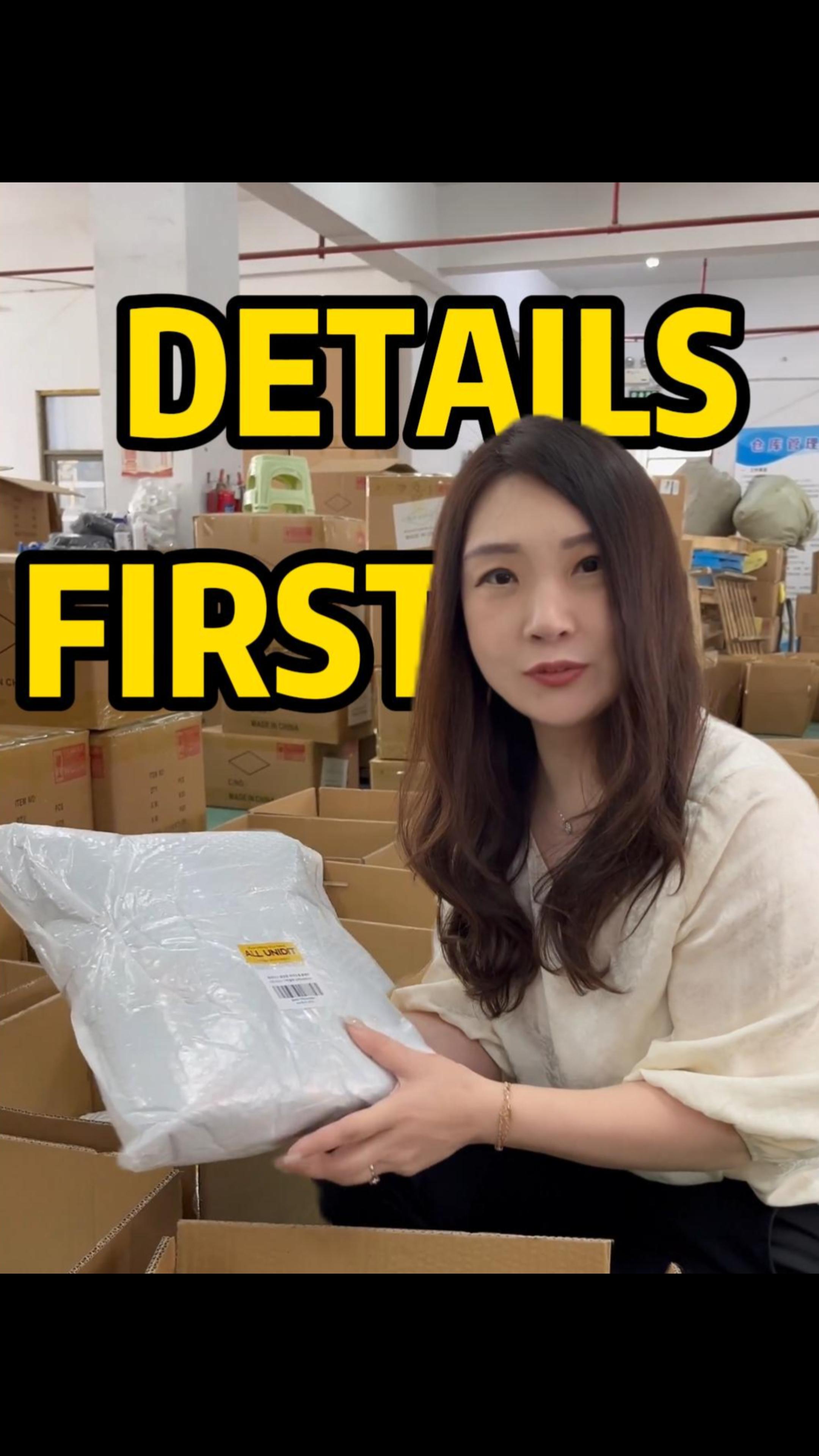
What Should You Check Before Shipping an Order From China?
The price looks good.
The minimum order quantity works.
The lead time is acceptable.
Does that mean the order is ready to ship?
Not yet.
Many sourcing problems do not come from the big decisions. They come from small details that were never checked carefully before shipment.
A wrong label, incorrect quantity, damaged package, or missing barcode may look like a small mistake in a warehouse in China—but it can become a much bigger problem after the goods arrive overseas.
That is why buyers should confirm the details before the shipment leaves China.
Price, MOQ, and Lead Time Are Only the Beginning
When buyers compare suppliers, they usually start with three questions:
What is the price?
What is the MOQ?
How long is the lead time?
These are important.
But they mainly determine whether the order is commercially possible.
They do not confirm whether the finished shipment is actually correct.
Before shipping, buyers should also verify whether the physical goods match the final agreed requirements.
That includes details such as:
Product quantity
Product specifications
Labels
Barcodes
Packaging
Carton information
Product appearance
Basic functions where applicable
The earlier these details are checked, the easier they are to correct.
1. Check the Final Quantity
Quantity seems simple, but mixed orders can make it complicated.
A buyer may order:
Several colors
Several models
Different sizes
Multiple SKUs
Products from several suppliers
The total quantity may be correct while individual variations are wrong.
For example:
| Variation | Ordered | Received |
|---|---|---|
| Black | 50 | 50 |
| White | 30 | 20 |
| Green | 20 | 30 |
| Total | 100 | 100 |
The total is still 100 pieces.
But the order is not correct.
That is why quantity should be checked against the approved SKU, color, size, or model breakdown—not only the overall number.
2. Check Product Labels
Labels are easy to overlook because they are small.
But for many buyers, they are essential.
Depending on the product and destination, labels may contain:
Product name
SKU
Barcode
Size
Color
Country-of-origin information
Brand information
Warning information
Handling instructions
Other buyer-required information
Before shipment, buyers should confirm:
Is the correct label used?
Is it applied to the correct product?
Is the information accurate?
Is the printing readable?
Is the position correct?
Are labels consistent across the order?
A perfectly good product with the wrong label can still create a receiving or retail problem.
3. Check Barcodes Carefully
Barcodes should not be treated as decoration.
If a buyer uses barcodes for retail, ecommerce fulfillment, warehouse receiving, or inventory management, the code needs to match the correct SKU.
Common risks include:
Wrong barcode on the correct product
Correct barcode on the wrong variation
Poor printing
Barcode covered by another label
Duplicate or outdated labels
Barcode positioned where it is difficult to scan
For multi-SKU orders, products should be clearly separated before labels are applied.
This reduces the risk of one product variation receiving another variation's label.
4. Check the Packaging
Packaging has two jobs:
Protect the product.
Prepare it for the buyer's sales and logistics process.
Before shipment, check whether the packaging matches the agreed requirement.
This may include:
Individual packaging
Retail box
Polybag
Product insert
Custom packaging
Barcode placement
Logo
Warning labels
Carton packaging
The packaging should also be checked for visible problems such as:
Crushed boxes
Open packaging
Poor sealing
Incorrect printing
Missing accessories
Damaged retail packaging
Packaging problems are easier to solve before international transportation begins.
5. Check Product Appearance
Finished products should be reviewed for visible workmanship issues.
Depending on the product, this may include:
Scratches
Stains
Cracks
Poor stitching
Loose threads
Uneven printing
Surface marks
Color differences
Incorrect assembly
Visible deformation
Not every cosmetic issue has the same importance.
The inspection standard should match the product, price level, sales channel, and buyer requirements.
The purpose is not to expect every inexpensive consumer product to be perfect.
The purpose is to identify issues that fall outside the agreed standard.
6. Confirm Dimensions When They Matter
A product can look correct but still have the wrong dimensions.
For relevant products, finished-goods checks may include:
Length
Width
Height
Thickness
Capacity
Component dimensions
Dimensions can affect:
Product function
Customer expectations
Retail packaging
Shipping volume
Compatibility with other products
If dimensions are important to the buyer, they should be included in the confirmed specification before the order and checked again when appropriate before shipping.
7. Check Basic Functions
For products with functional components, appearance alone is not enough.
Depending on the product, a basic function check may include:
Opening and closing
Folding
Assembly
Buttons or switches
Fit between components
Simple operation
Stability
Basic product use
The exact check should be defined according to the product.
A product that looks correct but does not perform its basic function is still unacceptable.
8. Check the Quantity Per Carton
The total order quantity is one level.
Carton packing is another.
Buyers may need to confirm:
Units per carton
Number of cartons
SKU distribution
Color distribution
Carton dimensions
Gross weight
Carton identification
This becomes especially important when products are going to:
Retail warehouses
Distributors
Ecommerce fulfillment centers
Amazon FBA
Multiple final destinations
Clear carton information makes receiving and inventory management easier after delivery.
9. Check Shipping Marks and Carton Information
Outer cartons may need specific identifying information.
Depending on the order, this can include:
Product name
Item number
Quantity
Carton number
Destination
Buyer reference
Shipping marks
Before dispatch, buyers should confirm that the outer-carton information matches the actual goods.
This is particularly useful when several products or suppliers are combined into one shipment.
Why Do Small Details Create Big Problems?
Because international sourcing creates distance.
If a label is wrong while the product is still in a warehouse in China, it may be possible to relabel the goods.
If the same problem is discovered after thousands of units arrive overseas, fixing it may require:
Additional warehouse labor
Repacking
Relabeling
Inventory delays
Returns
Extra transportation
Customer-service costs
The physical mistake is the same.
The cost of correcting it is completely different.
That is why early checking matters.
Should Buyers Wait Until the Final Day to Check Everything?
No.
Some details should be confirmed before final packing begins.
For example:
Label files
Barcode information
Packaging design
SKU breakdown
Product specifications
Waiting until the shipment is already packed can create unnecessary rework.
A better sequence is:
Confirm requirements → Prepare goods → Check finished products → Confirm packaging and labels → Release for shipment
This gives the supplier or warehouse more time to correct issues when something does not match.
What Should Be Confirmed Before the Order Is Placed?
Before placing the order, buyers should ideally confirm:
Product model
Quantity
Color or size breakdown
Price
MOQ
Product specifications
Packaging requirements
Labels and barcodes
Customization
Expected lead time
Destination market
These become the reference points for later checks.
If the original requirement is unclear, it becomes difficult to determine whether the finished product is correct.
What Should Be Checked After the Goods Are Finished?
Once finished products are available, the focus shifts from requirements to physical verification.
Depending on the product and agreed inspection scope, checks may include:
Appearance
Quantity
Dimensions
Basic functions
Labels
Barcodes
Packaging
Final shipment details
This helps identify visible or measurable discrepancies before release.
Is This the Same as Factory Production Inspection?
No.
Different sourcing companies provide different levels of quality-control service.
At Youshow, our quality-control focus is on finished products and pre-shipment confirmation.
We do not rely on claims about raw-material or semi-finished production inspections that are outside our normal service scope.
Our finished-product checks may cover:
Appearance
Quantity
Dimensions
Basic functions
Labels
Packaging
Final pre-shipment confirmation
The specific inspection points depend on the product and the buyer's requirements.
What Happens If a Problem Is Found?
Finding a problem does not automatically mean rejecting the entire order.
The first step is to understand:
What is wrong?
How many units are affected?
Does the problem affect function or appearance?
Does it violate the agreed requirement?
Can the supplier correct it before shipment?
Possible solutions may include:
Replacing affected units
Correcting labels
Repacking products
Recounting quantities
Separating defective items
Confirming an alternative solution with the buyer
The important point is that the problem is discovered while there is still an opportunity to respond.
Why Is a Written Order Specification Important?
Messages can easily become fragmented during a sourcing project.
One requirement may be sent by email, another through WhatsApp, and another mentioned during a video call.
Before the order is finalized, important requirements should be consolidated into a clear reference.
This may include:
| Item | Confirmed Requirement |
|---|---|
| Product | Model / SKU |
| Quantity | Total + variation breakdown |
| Size | Agreed dimensions |
| Color | Approved colors |
| Packaging | Standard / custom |
| Label | Required |
| Barcode | Buyer-provided |
| Logo | Position / method |
| Lead time | Agreed timeline |
A structured order record gives the sourcing team and supplier something clear to check against later.
Why Is This Especially Important for Repeat Orders?
Repeat orders can create a false sense of security.
A buyer may think:
“We ordered this before, so everything should be the same.”
But changes can still occur:
Different production batch
Packaging updates
Material substitutions
Different labels
Supplier staff changes
New carton arrangements
Small specification differences
Repeat orders should therefore still be checked against the required standard.
“Same product” should not mean “no need to confirm.”
What About Mixed-Product Orders?
Mixed-product sourcing creates even more detail management.
A buyer may have:
Ten different products
Five suppliers
Several colors
Different packaging
Different labels
One consolidated shipment
In this situation, a structured checking process becomes even more important.
Each product should be connected to:
Its supplier
Its quantity
Its SKU
Its packaging
Its labels
Its final shipment information
This reduces mistakes when several orders are handled at the same warehouse.
What Are the Most Important Details to Check?
If buyers want a simple pre-shipment reminder, start with these:
Product
Correct item
Correct color / size / model
Appearance acceptable
Required dimensions confirmed
Basic function checked where relevant
Quantity
Correct total quantity
Correct variation quantities
Labels
Correct product label
Correct SKU
Correct barcode
Readable printing
Packaging
Correct packaging
No obvious damage
Required accessories included
Cartons
Correct units per carton
Correct carton count
Required shipping information confirmed
These details may seem small individually.
Together, they determine whether the shipment arrives as the buyer expected.
How Can a Sourcing Company Help?
A sourcing company can act as the buyer's local coordination point before shipment.
Depending on the project, support may include:
Confirming final order requirements
Coordinating suppliers
Receiving goods
Checking quantities
Finished-product inspection
Checking labels and packaging
Consolidating products from different suppliers
Confirming shipment information
Coordinating international shipping
For overseas buyers, this creates an additional checkpoint while the products are still in China.
Conclusion
A good price, workable MOQ, and acceptable lead time are important.
But they are not enough.
Before shipping an order from China, buyers should confirm the details that determine whether the physical shipment actually matches the order:
Quantity
Product details
Labels
Barcodes
Packaging
Carton information
Small details are inexpensive to check early.
They can be expensive to fix later.
Good sourcing does not end when the price is agreed.
It ends when the right goods are ready to ship.
About Youshow
Youshow is a Yiwu-based sourcing company with 18 years of experience helping global buyers source products from China.
Our services include:
Product sourcing
Supplier comparison and evaluation
Sample collection
Finished-product quality inspection
Quantity confirmation
Label and packaging checks
OEM and ODM customization
Order consolidation
Export certification support
Worldwide shipping coordination
We help importers, wholesalers, retailers, Amazon sellers, and ecommerce businesses simplify procurement and reduce sourcing risks.
Before shipment, our finished-product checks can cover appearance, quantity, dimensions, basic functions, labels, packaging, and final shipment confirmation according to the product and buyer's requirements.
Because in international sourcing, the small details often determine whether delivery goes smoothly.