
What Happens If You Skip Final Inspection Before Shipping From China?
The products are finished.
The supplier says everything looks good.
The cartons are packed.
The shipping schedule is ready.
At this point, it can be tempting to say:
“Just ship it.”
But what happens if the products arrive overseas and only then you discover that something is wrong?
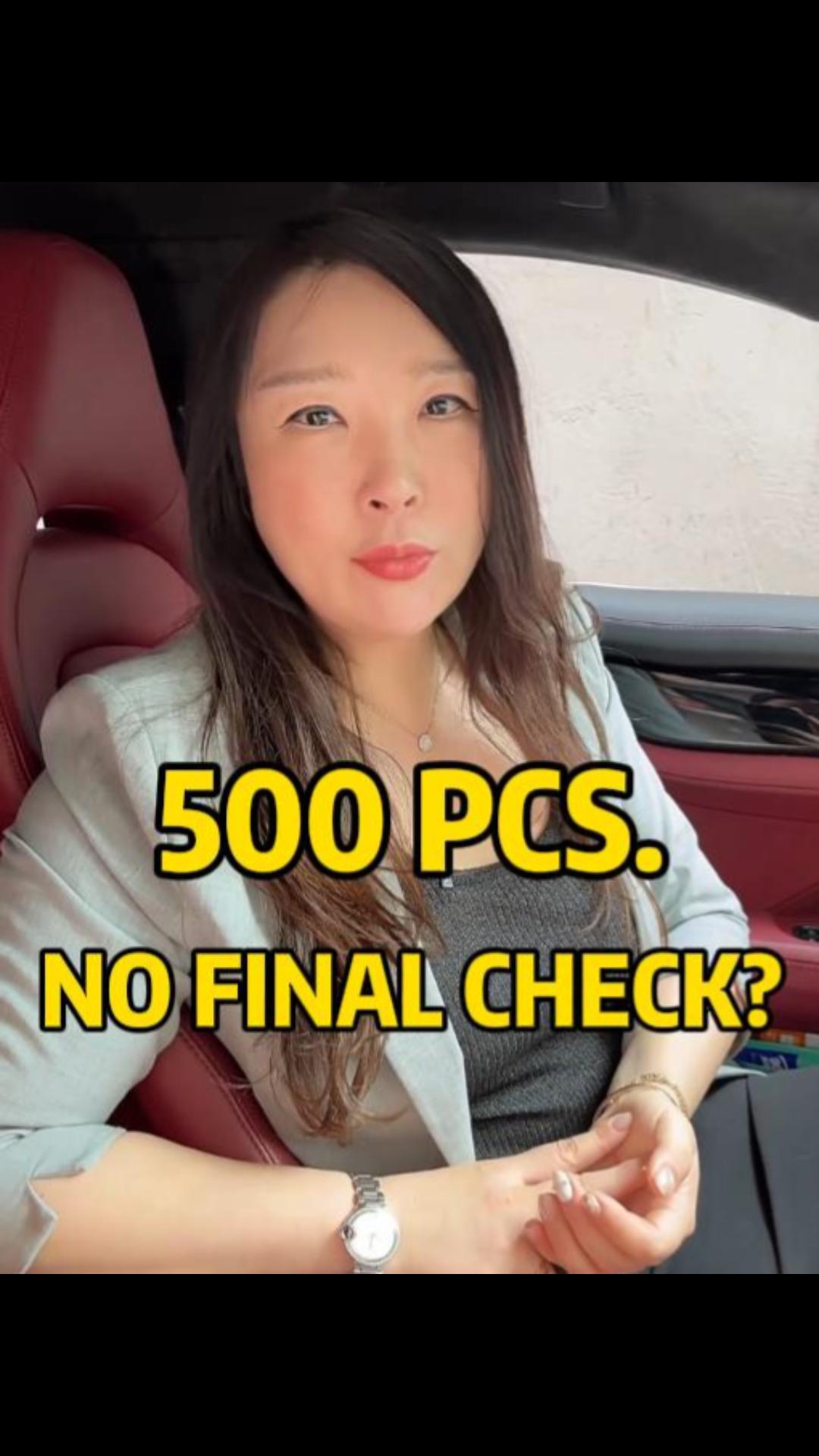
Imagine shipping 500 pieces without a final inspection.
After delivery, you open the cartons and find problems across a significant part of the order.
Now the problem is no longer sitting in a supplier's warehouse in China.
It is thousands of miles away.
You may need to sort the products, communicate with the supplier, arrange replacements, handle customer complaints, and possibly pay for another shipment.
The defect itself may not have changed.
What changed is where and when you found it.
That is why final inspection before shipment can be an important part of sourcing from China.
Why Does the Timing of Inspection Matter?
A quality problem discovered in China usually gives the buyer more options.
Depending on the issue, the supplier may still be able to:
Replace affected units
Rework products
Correct labels
Repack cartons
Add missing accessories
Recount quantities
Separate defective units
But after the goods have already shipped internationally, these options become more difficult.
The buyer may now face:
International freight already paid
Customs already completed
Warehouse receiving costs
Local labor
Customer returns
Replacement shipments
Lost selling time
The same product problem can therefore create very different business consequences depending on when it is discovered.
What Is a Final Inspection?
A final inspection is a check performed on finished products before the shipment is released.
At Youshow, our quality-control focus is on finished products and pre-shipment confirmation.
Depending on the product and buyer requirements, checks may include:
Appearance and workmanship
Quantity
Dimensions
Basic functions
Labels
Barcodes
Packaging
Carton information
Final pre-shipment confirmation
The exact checklist should match the product.
A pet accessory, kitchen product, storage item, and electronic product will not use exactly the same inspection points.
Is Final Inspection the Same as Checking a Sample?
No.
A sample helps buyers understand what the product is supposed to be.
The finished-order inspection checks whether the actual shipment reasonably matches the confirmed requirements.
Think of the process this way:
Sample = reference
Finished products = actual order
A good sample does not automatically mean every unit in the final shipment will be correct.
Production, packing, labeling, and handling happen after sample approval.
That is why buyers should not stop quality management at the sample stage.
“The Supplier Said It Was Fine.” Is That Enough?
Supplier communication is important, but it is not the same as independent verification.
A supplier may sincerely believe the order is ready.
However, mistakes can still occur during:
Production
Sorting
Assembly
Packing
Labeling
Carton preparation
For example:
The product itself may be correct, but the wrong color quantities are packed.
Or:
The quantity may be correct, but some labels are wrong.
Or:
The sample may have worked correctly, while some finished units have basic functional issues.
A final check creates another opportunity to identify these problems before shipment.
What Can Go Wrong Without a Final Check?
Problems vary by product, but several categories appear repeatedly in international sourcing.
1. Appearance and Workmanship Problems
Finished products may have visible issues such as:
Scratches
Stains
Cracks
Poor printing
Uneven stitching
Loose threads
Surface marks
Color differences
Incorrect assembly
Deformation
Some issues may be minor.
Others may make the product unsuitable for the buyer's market.
The agreed quality standard should determine what is acceptable.
2. Quantity Problems
An order can be short even when the carton count looks correct.
For example:
Buyer ordered:
500 PCS
Supplier packed:
485 PCS
Or the total may be correct while the variation quantities are wrong.
For example:
Black: ordered 200, received 160
White: ordered 150, received 190
Blue: ordered 150, received 150
Total:
500 PCS
The total looks correct.
The order is still wrong.
3. Wrong Colors, Sizes, or Models
Mixed-SKU orders create additional risk.
A buyer may purchase:
Several colors
Multiple sizes
Different models
Several packaging versions
If these variations are not checked carefully, the buyer may receive the wrong assortment.
This can create problems even when every physical product is technically usable.
4. Basic Function Problems
For products with functional elements, appearance alone is not enough.
Depending on the product, a basic function check may include:
Opening and closing
Folding
Assembly
Buttons
Switches
Fit between components
Basic operation
Stability
A product may look perfect in the carton and still fail during use.
5. Missing Accessories
Some products include:
Screws
Chargers
Cables
Lids
Straps
Instructions
Spare parts
Connectors
If one essential component is missing, the entire product may be difficult or impossible for the customer to use.
For kits and sets, component checking is especially important.
6. Label and Barcode Problems
Products may be physically correct but commercially unusable if labels are wrong.
Possible problems include:
Wrong SKU
Wrong barcode
Wrong size label
Incorrect color information
Poor printing
Labels on the wrong variation
Missing buyer-required labels
These issues can cause receiving, inventory, retail, or fulfillment problems after delivery.
7. Packaging Problems
Packaging should protect the product and match the buyer's confirmed requirements.
Possible issues include:
Damaged boxes
Weak cartons
Incorrect packaging
Missing inserts
Incorrect printing
Poor sealing
Products moving excessively inside the carton
A good product can still arrive in poor condition if the packaging is inadequate.
Why Is It More Expensive to Find Problems After Shipping?
Consider a simple scenario.
You order:
500 units
The supplier finishes production and immediately ships the goods.
After arrival, you discover that many units have problems.
Now you may need to pay for:
Local Sorting
Someone has to open cartons and identify which units are usable.
Warehouse Labor
Products may need to be counted, separated, photographed, repacked, or relabeled.
Supplier Communication
Evidence needs to be collected and the problem discussed.
Replacement Products
The supplier may need to manufacture or prepare replacements.
Additional Shipping
Replacement products still need to travel from China to the destination country.
Customer Delays
You may not have enough sellable inventory to fulfill orders.
Lost Selling Time
For seasonal products, even a short delay may matter.
This is why inspection should not be viewed only as an additional cost.
Buyers should compare that cost with the potential cost of solving problems after international shipment.
Does Inspection Guarantee Zero Defects?
No.
This is an important expectation to set correctly.
Quality inspection reduces risk; it does not guarantee that every shipment will contain zero defects.
The result depends on:
Inspection method
Sample size
Product type
Quality standard
Defect distribution
Buyer requirements
Some inspections use sampling rather than checking every single unit.
Therefore, professional quality control should be understood as a risk-management process, not a guarantee of perfection.
Should Every Unit Be Inspected?
Not necessarily.
The appropriate inspection approach depends on:
Product value
Order size
Product complexity
Historical supplier performance
Buyer requirements
Consequences of defects
For some products, sampling may be appropriate.
For others, certain critical points may require broader checking.
The inspection scope should be discussed before the goods are released.
When Should Final Inspection Happen?
The ideal timing depends on the order, but the key principle is:
The products should be sufficiently complete to inspect, while there is still time to correct problems before shipment.
If the inspection happens too early, the complete order may not yet be available.
If it happens after the goods leave China, the opportunity for practical correction becomes much smaller.
That is why final pre-shipment confirmation is important.
What Should Be Confirmed Before Inspection?
Inspection works better when there is a clear reference.
Before the order is produced, buyers should confirm important requirements such as:
Product model
Quantity
Size
Color
Material
Basic function
Packaging
Logo
Labels
Barcode
Accessories
Otherwise, the inspector may see a product but have no clear standard to compare it against.
Quality control starts with clear specifications.
Why Is Sample Approval Important?
A physical sample can help establish expectations for:
Appearance
Dimensions
Material
Color
Function
Packaging
For suitable projects, the confirmed sample can become one reference for the finished order.
However:
Sample approval ≠ automatic final-order approval.
The finished goods still need to be evaluated separately.
What Happens If a Problem Is Found Before Shipment?
The first step is to understand the scope.
Ask:
What is the problem?
How many units appear affected?
Is it cosmetic or functional?
Does it violate the confirmed requirement?
Can it be corrected?
How much time is required?
Possible responses may include:
Rework
The supplier corrects affected products.
Replacement
Defective units are replaced with acceptable units.
Relabeling
Incorrect labels or barcodes are corrected.
Repacking
Packaging problems are fixed.
Sorting
Affected units are separated from acceptable units.
Buyer Decision
For certain minor issues, the buyer may decide whether the products are commercially acceptable.
The correct response depends on the specific defect and buyer requirements.
Why Is Evidence Important?
When a problem is found, clear evidence makes communication easier.
This may include:
Photos
Videos
Quantity records
Measurements
Product references
Label photos
Packaging photos
Instead of telling the supplier:
“Quality is bad.”
it is more useful to say:
“During the check, these units showed this specific issue.”
Specific information makes the next action easier to discuss.
Who Should Decide Whether the Goods Can Ship?
The buyer should remain involved in important quality decisions.
A sourcing company can inspect, document, and report the findings.
But when an issue falls into a gray area, the buyer may need to decide whether:
The order can ship
Rework is required
Replacement is required
A minor deviation is acceptable
The sourcing team should provide enough information for the buyer to make that decision.
What About Repeat Orders?
Repeat orders still need attention.
A buyer may think:
“We already ordered this product before. The first shipment was good.”
But later orders can involve changes such as:
Different production batch
Different workers
Updated packaging
Material changes
New labels
Different carton arrangement
New component suppliers
Repeat-order consistency should therefore be verified rather than assumed.
What About Trusted Suppliers?
Trust and inspection are not opposites.
A buyer may have worked with the same supplier for years and still maintain a quality-control process.
The purpose is not to accuse the supplier of dishonesty.
It is to manage a repeatable business process.
Good suppliers can also make mistakes.
A structured final check protects both sides by identifying issues before they become expensive disputes.
“Why Don't You Trust Me?”
This is the question behind the video.
The answer is:
Quality control is not about distrust.
It is about verification.
Businesses verify:
Quantities
Payments
Documents
Inventory
Shipping information
Product quality should be treated the same way.
A professional supplier should understand that checking finished goods is part of international trade.
What Should Buyers Check Before Giving the Final Shipping Approval?
A simple checklist can include:
Product
Correct model
Correct color
Correct size
Appearance acceptable
Dimensions checked where relevant
Basic function checked where relevant
Quantity
Total quantity confirmed
Variation quantities confirmed
Accessories
Required components included
Sets complete
Labels
Correct SKU
Correct barcode
Required information present
Packaging
Correct packaging
No obvious damage
Products protected
Cartons
Carton quantity confirmed
Units per carton confirmed
Required carton information correct
Once the agreed checks are complete, the order can move toward shipment approval.
Can Inspection Be More Important for Small Businesses?
It can be particularly important when a business has limited inventory.
Suppose a large retailer receives 10,000 products and has a relatively small problem rate.
It may have more resources to sort or redistribute inventory.
Now imagine a small ecommerce seller receives only 500 pieces and a large share of them cannot be sold.
That can affect:
Available inventory
Cash flow
Product launch
Customer orders
Advertising
Reorder timing
Small businesses may therefore have less room to absorb sourcing mistakes.
Should Buyers Inspect Every Order?
The quality-control plan should reflect the buyer's actual risk.
Factors include:
Supplier history
Product complexity
Order quantity
Product value
Previous problems
Destination requirements
Sales channel
Some repeat orders from highly stable suppliers may use a different inspection scope from a first order with a new supplier.
But removing quality control entirely simply because the supplier has been reliable should be a deliberate business decision—not an assumption.
How Can a Sourcing Company Help?
For overseas buyers, a sourcing company can act as a local checkpoint before products leave China.
Depending on the project, support may include:
Confirming final order requirements
Coordinating suppliers
Receiving finished goods
Checking appearance and workmanship
Confirming quantities
Checking dimensions
Checking basic functions
Reviewing labels and packaging
Reporting problems
Coordinating corrective action
Consolidating goods
Final pre-shipment confirmation
Worldwide shipping coordination
This gives buyers another opportunity to understand the condition of the goods before international transportation begins.
Inspection vs. Fixing Problems Overseas
The comparison is simple.
Problem Found in China
Possible actions:
Check → Report → Rework / Replace → Confirm → Ship
Problem Found After Arrival
Possible actions:
Receive → Discover → Sort → Report → Negotiate → Replace → Ship Again
The second process contains more steps, more distance, and potentially more cost.
That is the real value of catching problems before shipment.
A Better China Sourcing Process
Instead of:
Order → Production → Ship → Hope
use:
Order requirements
↓
Sample confirmation
↓
Supplier coordination
↓
Finished products
↓
Final inspection
↓
Correct problems if necessary
↓
Shipment approval
↓
Shipping
Quality control becomes a planned part of the sourcing process rather than an emergency response.
Conclusion
Skipping final inspection can look like a way to save time or money.
But if a problem is discovered after the goods arrive overseas, the cost of fixing it may be much higher.
You may already have paid for:
The products
Packaging
International freight
Customs
Warehousing
And the goods may still need to be sorted, replaced, or shipped again.
That is why the better question is not:
“Do you trust the supplier?”
The better question is:
“Where would you rather discover the problem—in China before shipment, or after the goods arrive?”
Trust your supplier.
But verify the finished order.
About Youshow
Youshow is a Yiwu-based sourcing company helping global buyers source and manage products from China.
Our services include:
Product sourcing
Supplier comparison and evaluation
Sample collection
Finished-product quality inspection
Quantity confirmation
Dimensions and basic-function checks
Label and packaging checks
Final pre-shipment confirmation
OEM and ODM customization
Order consolidation
Export certification support
Worldwide shipping coordination
We help importers, wholesalers, retailers, Amazon sellers, and ecommerce businesses simplify procurement and reduce sourcing risks.
Our quality-control focus is on finished products before shipment. Depending on the product and agreed requirements, our team can check appearance, quantity, dimensions, basic functions, labels, packaging, and other confirmed finished-product details.
The goal is simple: identify problems while there is still an opportunity to deal with them in China.

